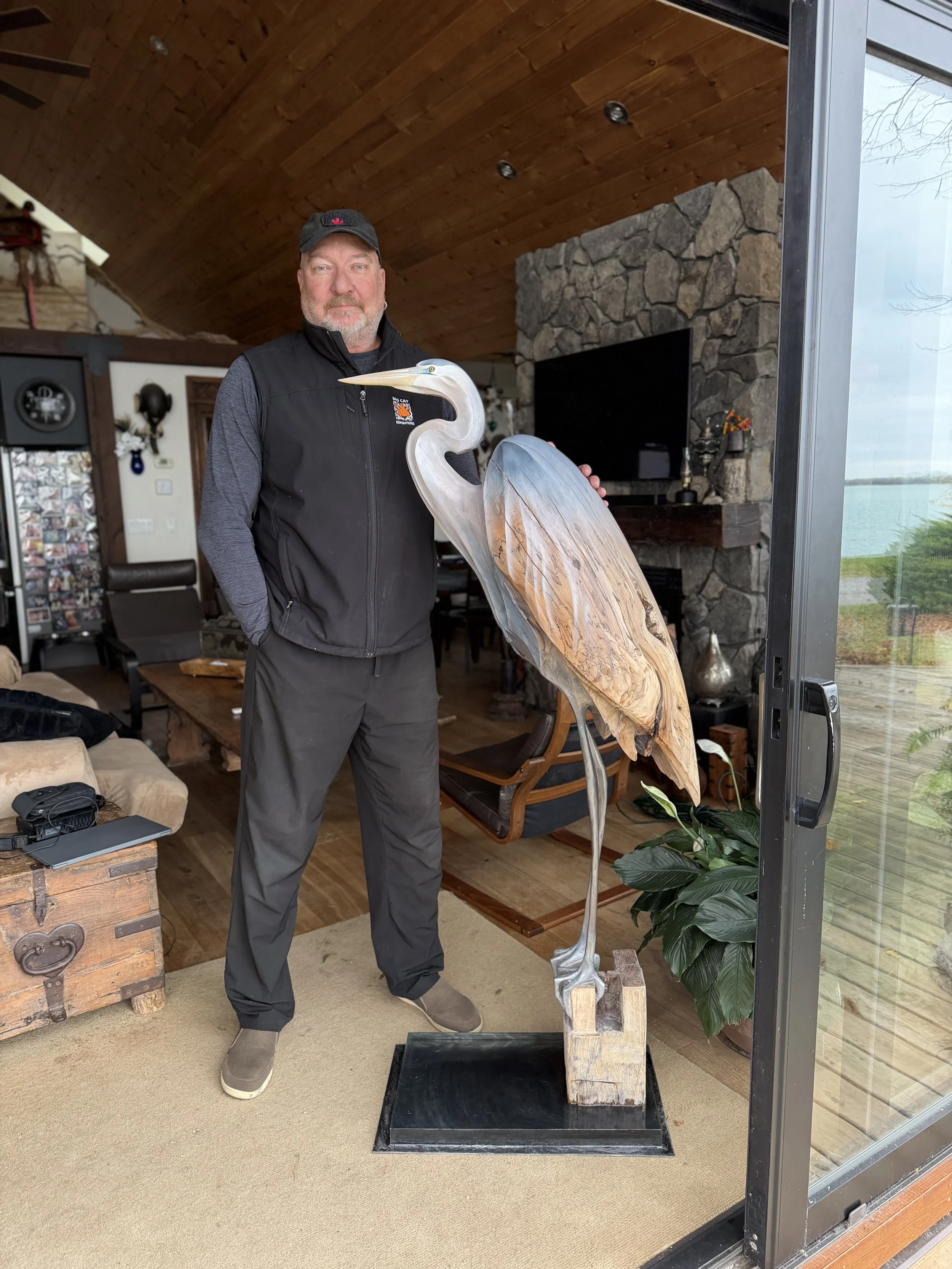
Sometimes, the greatest reward of creating a work of art is discovering where it was meant to belong.
As artists, we don’t often have the pleasure of witnessing the full fruits of our labour. We spend countless hours in our studios, consumed by the process of creating something, and somewhere along the way, the work leaves our hands to begin a life of its own.
Every once in a while, though, we’re fortunate enough to witness the beginning of that next chapter. This past Monday was one of those moments for me.
It marked the conclusion of a particularly long journey with a sculpture I’ve come to call Stillness, a Great Blue Heron carved from spalted maple, with hand-forged stainless steel legs and a reclaimed wood base.
For a sculpture that embodies patience and tranquillity, its creation involved surprisingly little of either.
From the Side of the Road
The story began roughly two years ago when I stumbled across a four-foot section of a tree trunk left at the curb following the removal of a tree.
Naturally, being an artist who sees potential in things most people are trying to get rid of, I decided I needed it.
Getting it home was another matter. The trunk was so heavy that I couldn’t quite manoeuvre it into my little Honda Fit. Being only two blocks from home, I figured I could manage with the hatch open.
Well, I turned a corner, and the entire thing rolled onto the road.
Thankfully, a kind stranger pulled over and helped me load it back into the car. I’d like to think that was the first of many helping hands that would eventually bring this sculpture to life.
The wood sat in my backyard for about a year and a half, receiving the occasional generous application of mineral oil in an attempt to minimize premature splitting, while I waited for an idea to present itself.
When that idea finally came, it wasn’t actually a heron. It was a Great Egret.
A Material with a Mind of Its Own
Having spent much of my artistic career carving stone, working with a piece of spalted maple of this size presented an entirely different set of challenges.
The beautiful black lines that weave their way through spalted wood are the result of fungal activity. While visually extraordinary, the process can also compromise the integrity of the wood. Sections of the heartwood had softened considerably, while neighbouring areas remained remarkably dense.
I eventually began to memorize the geography of the material, knowing where I could confidently apply pressure with a tool and where the slightest misjudgement could remove more than I intended.
This was also my first experience using a chainsaw as a carving tool. There was something liberating about removing such large quantities of material, although that freedom quickly gave way to the meticulous refinement that tends to consume most of my time as an artist.
The intention was always to find a balance between the natural character of the wood and the anatomy of the bird. I wanted to impose enough of my own vision upon the material to bring the creature to life, without disguising the history that the wood already possessed.
That balance became increasingly important as the work progressed.
Returning to the Forge
I had initially underestimated the complexity of constructing the legs. I figured I could source some stainless steel and, with a little ingenuity, shape it into something resembling the anatomy of a bird.
As is often the case with my artistic endeavours, things escalated rather quickly.
I reached out to my former blacksmithing instructor from my days at the Haliburton School of Art + Design, who generously welcomed me into her studio. What was intended to be one day of blacksmithing turned into two.
Working with a coal forge, a pneumatic power hammer and some rather ambitious lengths of stainless steel, I found myself revisiting skills I hadn’t put to use in quite some time. Those two days were invaluable, filled with shared knowledge, problem-solving and a renewed appreciation for the craft of blacksmithing.
Back in my own studio, an engine hoist became an unlikely addition to my sculpting tools as I worked to position the body and accurately mount the legs.
I even managed to install the reclaimed wood base backwards at one point. After a good laugh at my own expense and a little head-scratching, everything was turned around, and to my relief, the bird stood beautifully balanced.
It was finally finding its footing.
An Unexpected Encounter
The timing of the blacksmithing phase coincided nicely with a live carving demonstration I was doing outside the Upper Canada Native Art Gallery in Niagara-on-the-Lake.
I always enjoy these opportunities. Working outside the confines of my dusty studio, engaging in conversations with passersby and hearing their stories brings another dimension to the creative process.
I was also rather amused to discover that I had apparently earned the reputation of being the owl guy among some of the gallery’s visitors.
It was during this demonstration that I was introduced to Lisa Elliott.
We struck up a conversation about herons and egrets, sharing our observations and experiences with these remarkable birds. At the time, I was already contemplating a transition from the original Great Egret to a Great Blue Heron, as the proportions of the emerging sculpture seemed to lend themselves more naturally to the latter.
Lisa expressed a connection to the work, and I happily agreed to keep her updated as it progressed.
I later learned that she had been considering it as a gift for her husband, wildlife artist Edward Spera, whose work I’ve admired for quite some time.
Beyond his extraordinary paintings, I’ve always appreciated Edward’s dedication to experiencing wildlife firsthand, travelling to observe and photograph his subjects in their natural environments. There is a level of authenticity in that approach that I greatly admire and aspire to explore further within my own artistic practice.
Our encounter that afternoon gave the sculpture’s journey a rather unexpected direction.
The Art of Patience
The transition from an egret to a heron was more involved than I had anticipated.
Soft sections of wood in particularly sensitive areas required reinforcement, the beak was strengthened internally with brass, and various sculptural techniques were combined to compensate for the limitations of the original material.
There were admittedly a few moments while refining the contours of the feathers when I thought to myself that it might have been easier to carve the entire thing out of stone.
But stone could never replicate the intricate grain, knots and natural imperfections that gave this particular piece its character.
The final stages involved subtle airbrushing and acrylic detailing, establishing the distinctive colours of the Great Blue Heron while allowing the natural wood to remain an integral part of the composition.
What began as a project I had hoped to complete by the end of summer carried well into November. But as the work evolved, so did the standards I had set for it.
Perhaps there was something fitting about learning patience while sculpting a creature that has mastered the art of it.
A heron can stand motionless for an extraordinary length of time, waiting for precisely the right moment to act. There is an intention behind its stillness that I’ve come to appreciate even more through the creation of this piece.
Where It Was Meant to Be
When I finally reached out to Lisa to let her know the sculpture was complete, I discovered that, quite unknowingly, I had finished it just in time for her and Edward’s anniversary.
Somehow, despite all the delays, technical hurdles and unexpected turns, the timing couldn’t have been better.
After showing Lisa the completed sculpture, I had the pleasure of delivering it to Edward that same afternoon as a surprise.
What followed was one of those experiences that makes all the long hours in the studio worthwhile.
We shared stories of our experiences with herons, and hearing about the connection that Lisa and Edward have formed with these birds over the years made the occasion all the more meaningful.
Edward was also generous in sharing some of his experiences and advice as an artist. These are the sorts of conversations I treasure — the opportunity to exchange ideas, learn from someone further along in their artistic journey, and carry a little of that wisdom forward into my own.
It is a wonderful feeling to know that a work you’ve invested so much of yourself into has found a home where its subject holds such genuine meaning.
Finding My Own Wings
Admittedly, I still feel a little like a fledgling trying to find its wings.
Balancing life as a father, a husband, a full-time assembly-line worker at Toyota and an artist is an ongoing challenge. The artist in me rarely switches off, and my thoughts have a tendency to wander back into the studio, even when I’m nowhere near it.
Making the leap towards a life more devoted to art is something I aspire to. For now, I’m learning to make smaller, more deliberate leaps whenever the opportunity presents itself.
Experiences like this one serve as a reminder of why I continue to make them.
I’ve also come to appreciate the strange synchronicities that occasionally present themselves throughout life. Whether you attribute them to God, the universe, the Creator, or simply the beautiful unpredictability of life, there are moments when seemingly unrelated events come together in ways that are difficult not to appreciate.
A discarded tree trunk, a stranger on the side of the road, a former teacher, a carving demonstration, a chance encounter and an anniversary I knew nothing about.
None of it could have been planned quite so well.
My sincere gratitude goes out to Lisa and Edward for allowing me to be a small part of their story, and to everyone whose hands, knowledge and kindness contributed to this journey along the way.
Two years ago, a piece of wood was lying at the side of the road, its purpose seemingly exhausted.
Today, it stands quietly in its new home. Standing in front of a window, gazing at the waters, keeping watch.
And perhaps, after all this time, Stillness has found exactly where it was meant to be.