I’m going to let you in on a common secret that artists share. It’s a painful truth, one we hardly even admit to ourselves until someone pokes the bear.
We hate being told how or what to do.
I’m absolutely the worst for it. Stubborn to the core. But there’s a reason for that. If I weren’t, I probably wouldn’t be an artist.
Don’t get me wrong. I love opinions. I thrive on feedback and genuinely value the perspectives of others. But there’s a time and a place for it. Once a piece is complete, I’m happy to hear what people think. Until then, I’m often my own worst critic. I’ll occasionally seek the opinion of one trusted person at a time, but that doesn’t necessarily mean I’ll follow their advice. More often, I’ll try to understand where they’re coming from, reason through their criticism, and find my own way of addressing whatever isn’t working.
These are the strange ways artists operate.
We’re driven by an internal compass, one with a magnetic north that doesn’t quite align with true north. Even the people and circumstances around us can pull that needle in unexpected directions. Some days it points with absolute conviction; other days, it barely moves at all. Sometimes we don’t even know why. Keeping that direction alive is a secret we don’t entirely understand ourselves.
I’ve found this particularly true with my latest project, which has become one of the longest and most demanding pieces I’ve undertaken.
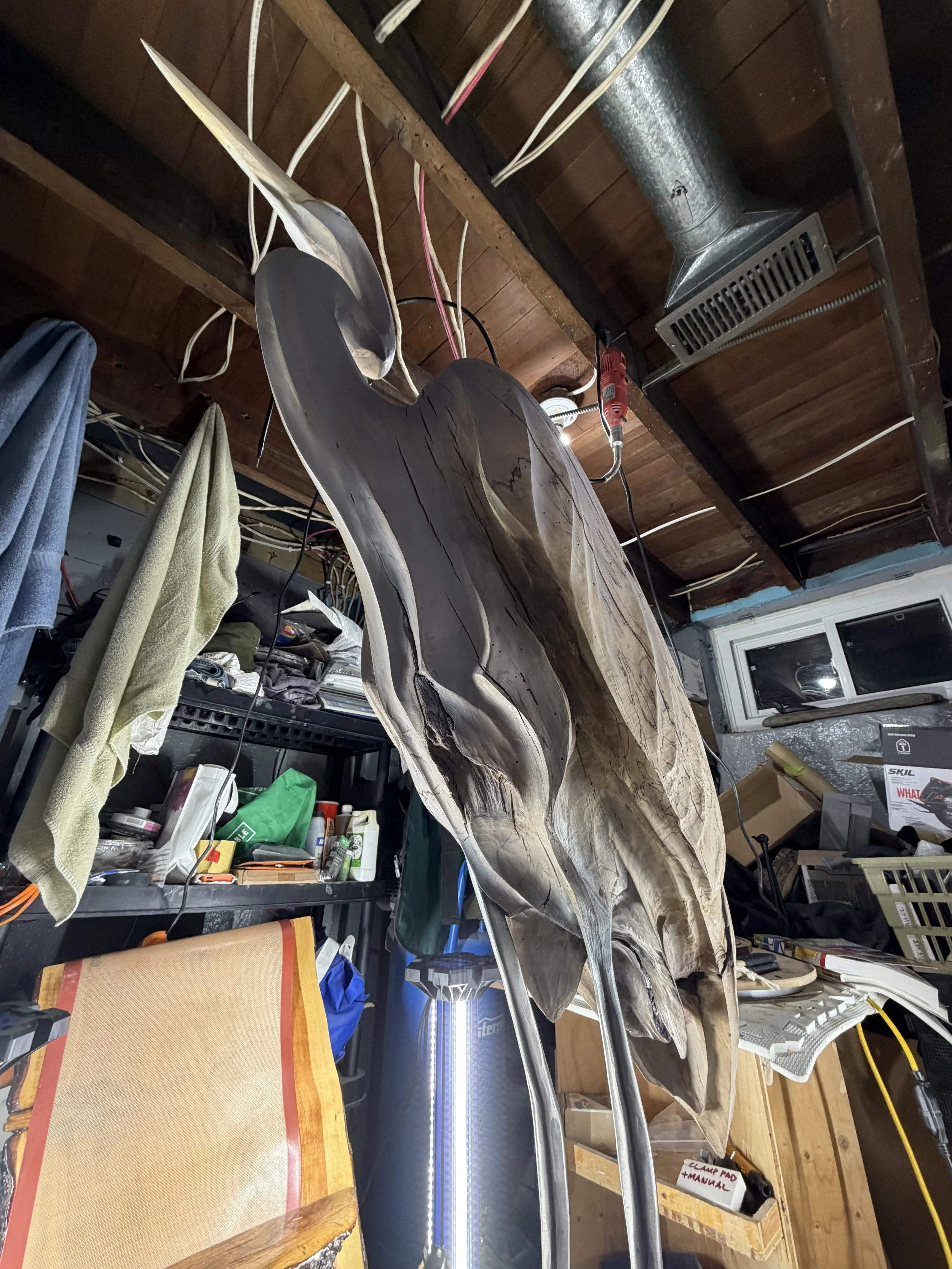
There’s a blue heron standing in my basement right now. It’s consumed an unreasonable amount of space, tools, time, and work just to get where it is. It started as a log that spent two years drying out before finally making its way onto a worktable. Eventually, I took a chainsaw to it.
Initially, I had imagined keeping it somewhat raw, perhaps simply adding a set of legs in some unconventional, almost hipster fashion. But the project kept evolving, for better or worse. Honestly, I’m not entirely sure which at this point. The critic in me is reaching the end of his rope, and I suspect he’s about ready to give up.
There’s a Japanese concept, wabi-sabi, that seems particularly fitting here: finding beauty in things that are imperfect, impermanent, and incomplete. Perhaps that’s where I’ve arrived with this piece. Not necessarily at a finished understanding of it, but somewhere along the way I’ve started appreciating the imperfections and unexpected directions it has taken.
In the late summer, I managed to pull together some time at a blacksmith’s forge to make the legs. This happened just two days before a live carving demonstration outside a gallery where I exhibit my work.
I love those opportunities to hear people’s genuine reactions and make connections through the work. After spending an exorbitant, and probably unhealthy, amount of time alone in the studio, it’s refreshing to step outside and share a little of the process. These small encounters build community, and I think the authenticity of showing how something is made is an important part of that.
During the demonstration, a young American fellow approached me, with his friend standing just behind him, and asked, “You didn’t carve that with that tool, did you?”
I humbly replied, “No,” holding up the wood rasp in my hand.
I understand the question. People see the tools and often have no idea how much work goes into a piece like this. Power tools are certainly part of the process when working into a massive block of maple, but the wood itself remains unpredictable. It has a character of its own, and that’s something I wouldn’t trade for the convenience of working with a more predictable material. In some ways, I might as well be carving marble.
But above all, I’d like to make one humble admission to that young American, who will almost certainly never read this:
I don’t know what I’m doing.
And I love that part.
I need to surprise myself every time. There’s something about reaching the end of a project and looking back at what has emerged that makes all the uncertainty worthwhile. Sometimes I look at the finished piece, or even revisit photographs of the process, and wonder how I managed to do it. I almost have to ask myself whether it was really me.
And perhaps, in some sense, it wasn’t entirely.
There’s something that happens in the space between intention and execution that I can’t quite explain. A blank space, perhaps, where the familiar rules fall away and something else takes over. I like to think there’s a guiding hand in there somewhere, working through us, regardless of which tools we choose or how we use them.
We have to leave room for that.
The work changes us just as much as we change the work. If we allow ourselves enough spontaneity, enough uncertainty, and enough willingness to follow an idea somewhere unexpected, we might find ourselves becoming something we hadn’t anticipated either.
That’s why I keep asking a little more of myself with every piece.
And this time, with the blue heron, I think I’ve bitten off more than I can chew. But knowing myself, I’ll probably bite off even more tomorrow.
Every new piece begins somewhere between an idea and a hope. We don’t always know where we’re going, or whether we’ll get there. Sometimes all we have is the willingness to begin.
To borrow a line from Gandalf in The Lord of the Rings:
“There never was much hope. Just a fool’s hope.”
Perhaps that’s all an artist really needs.