Stillness – Finding Our Wings
What began as a discarded tree trunk became a two-year journey of craftsmanship, patience, unexpected encounters and meaningful connections. From the roadside to the blacksmith's forge, and eventually into the home of wildlife artist Edward Spera and Lisa Elliott, Stillness serves as a reminder that sometimes the journey of creating art is as meaningful as the work itself.
Sometimes, the greatest reward of creating a work of art is discovering where it was meant to belong.
As artists, we don’t often have the pleasure of witnessing the full fruits of our labour. We spend countless hours in our studios, consumed by the process of creating something, and somewhere along the way, the work leaves our hands to begin a life of its own.
Every once in a while, though, we’re fortunate enough to witness the beginning of that next chapter. This past Monday was one of those moments for me.
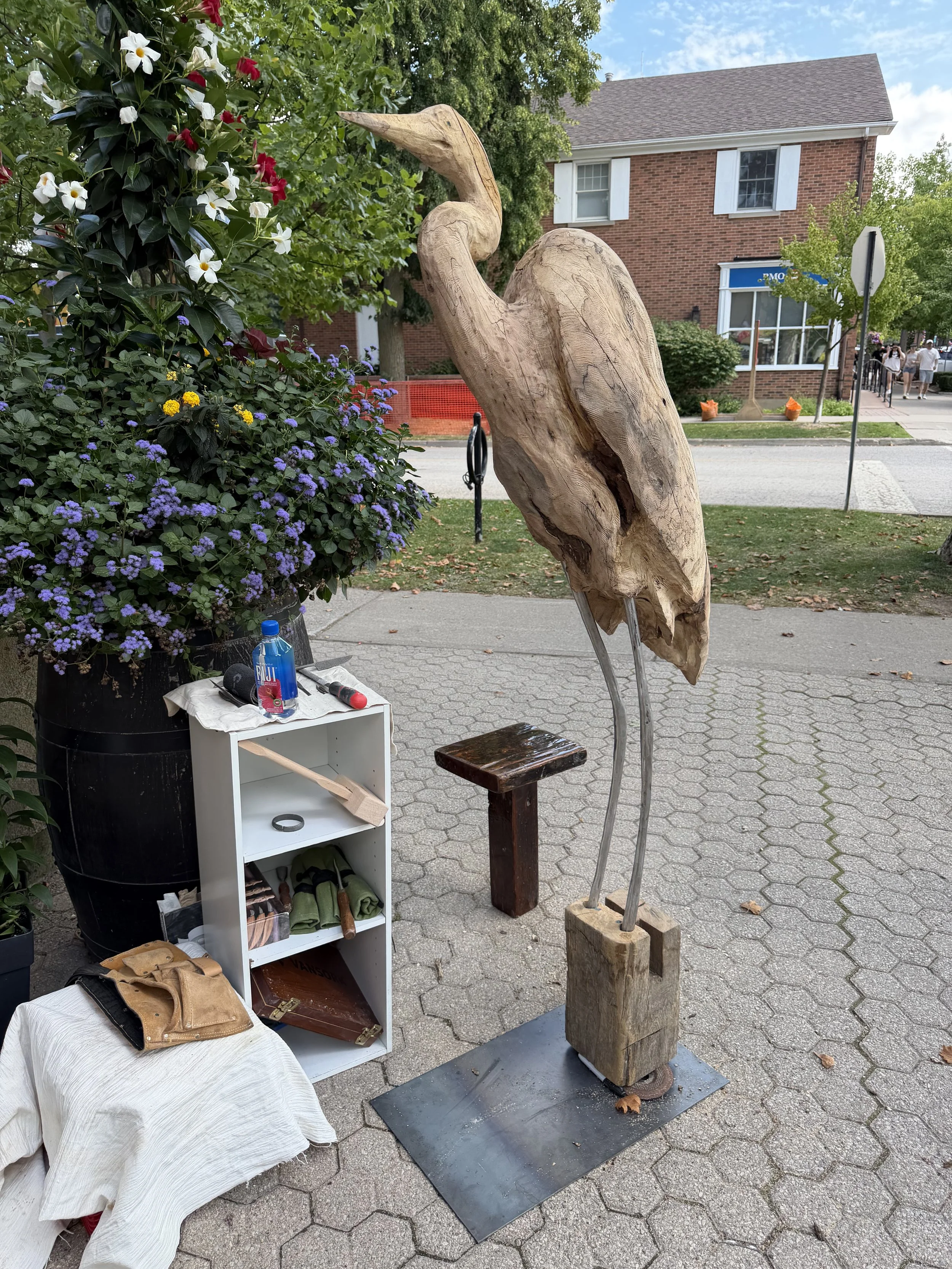
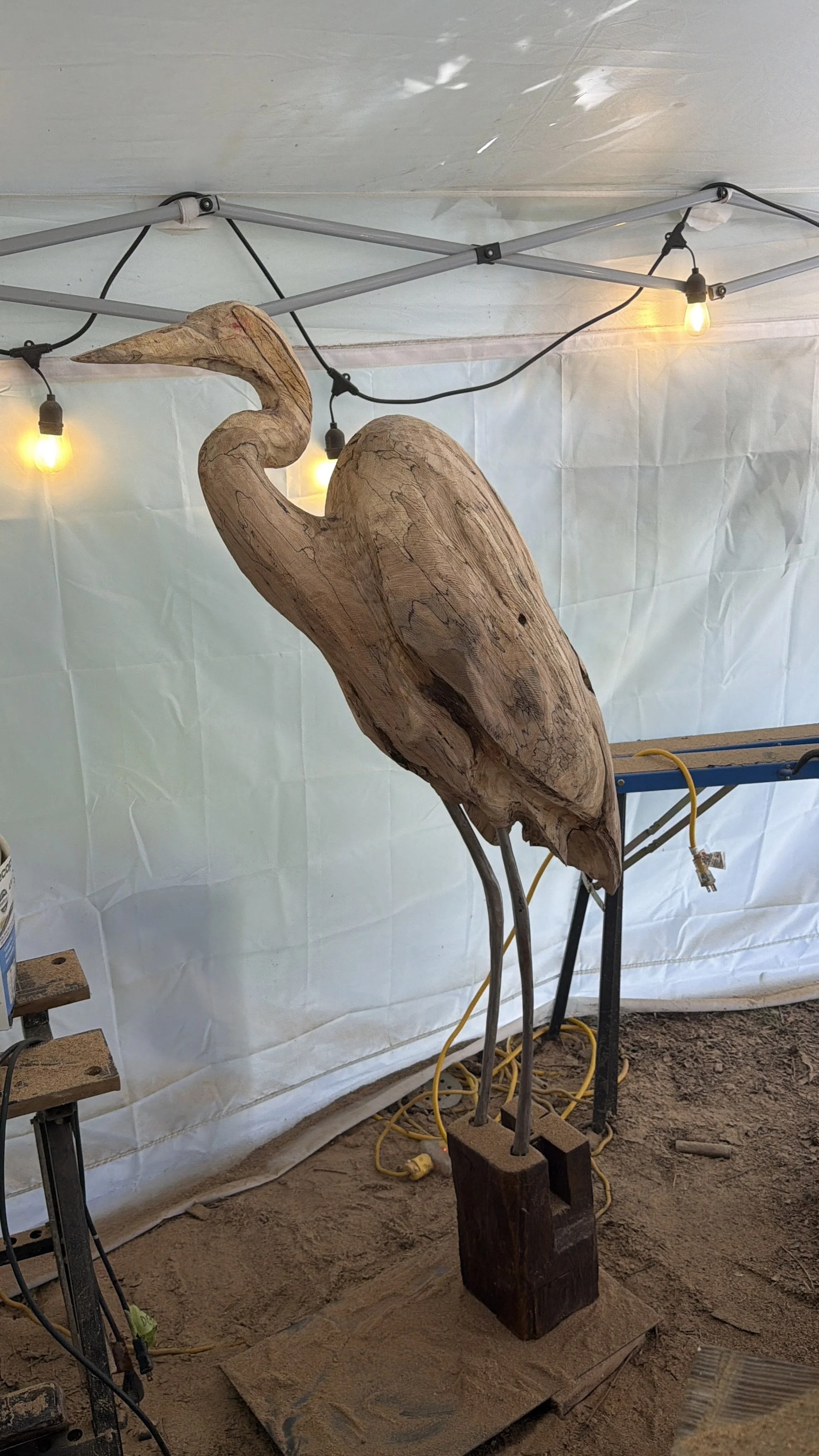
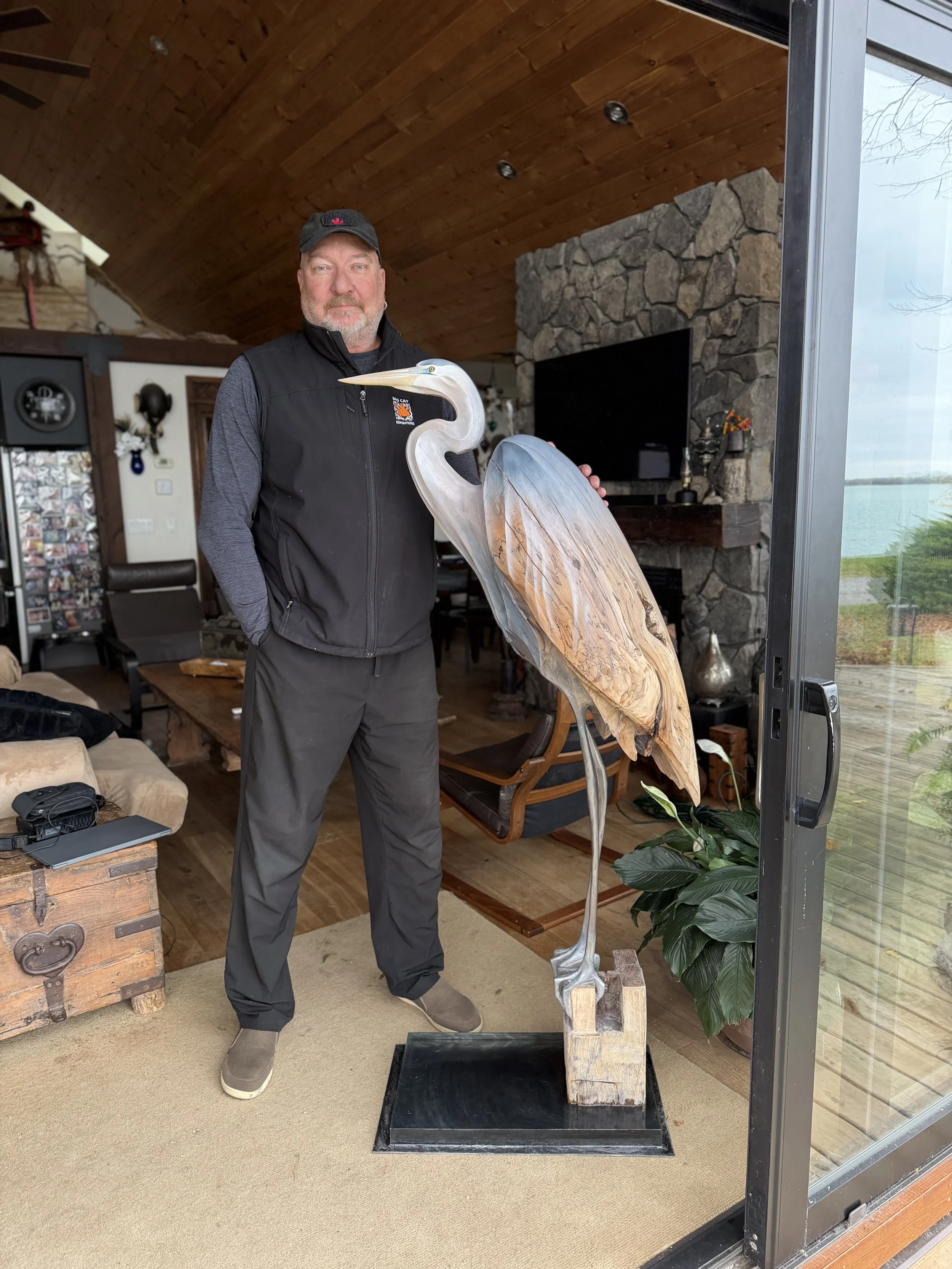
It marked the conclusion of a particularly long journey with a sculpture I’ve come to call Stillness, a Great Blue Heron carved from spalted maple, with hand-forged stainless steel legs and a reclaimed wood base.
For a sculpture that embodies patience and tranquillity, its creation involved surprisingly little of either.
From the Side of the Road
The story began roughly two years ago when I stumbled across a four-foot section of a tree trunk left at the curb following the removal of a tree.
Naturally, being an artist who sees potential in things most people are trying to get rid of, I decided I needed it.
Getting it home was another matter. The trunk was so heavy that I couldn’t quite manoeuvre it into my little Honda Fit. Being only two blocks from home, I figured I could manage with the hatch open.
Well, I turned a corner, and the entire thing rolled onto the road.
Thankfully, a kind stranger pulled over and helped me load it back into the car. I’d like to think that was the first of many helping hands that would eventually bring this sculpture to life.
The wood sat in my backyard for about a year and a half, receiving the occasional generous application of mineral oil in an attempt to minimize premature splitting, while I waited for an idea to present itself.
When that idea finally came, it wasn’t actually a heron. It was a Great Egret.
A Material with a Mind of Its Own
Having spent much of my artistic career carving stone, working with a piece of spalted maple of this size presented an entirely different set of challenges.
The beautiful black lines that weave their way through spalted wood are the result of fungal activity. While visually extraordinary, the process can also compromise the integrity of the wood. Sections of the heartwood had softened considerably, while neighbouring areas remained remarkably dense.
I eventually began to memorize the geography of the material, knowing where I could confidently apply pressure with a tool and where the slightest misjudgement could remove more than I intended.
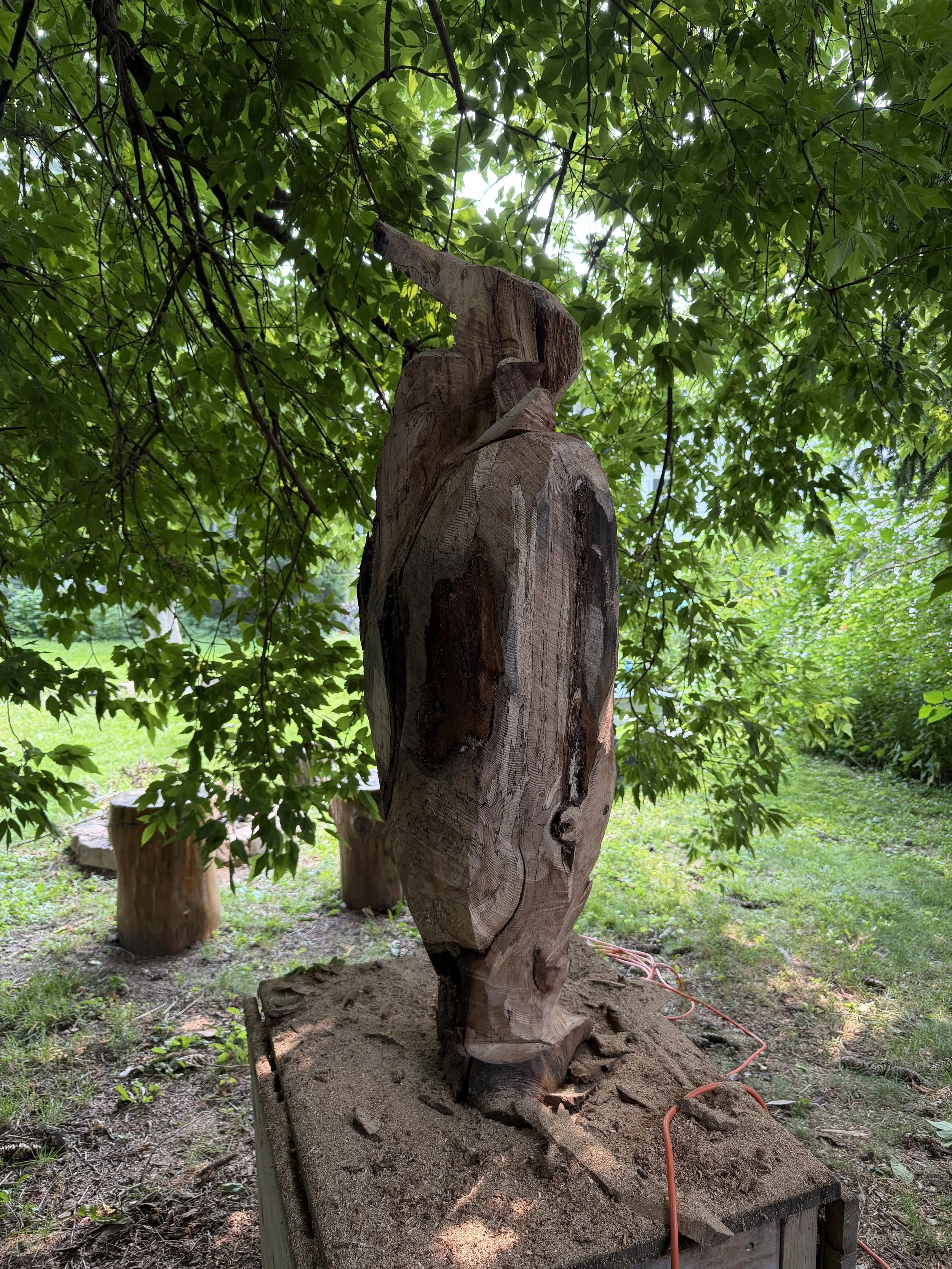
This was also my first experience using a chainsaw as a carving tool. There was something liberating about removing such large quantities of material, although that freedom quickly gave way to the meticulous refinement that tends to consume most of my time as an artist.
The intention was always to find a balance between the natural character of the wood and the anatomy of the bird. I wanted to impose enough of my own vision upon the material to bring the creature to life, without disguising the history that the wood already possessed.
That balance became increasingly important as the work progressed.
Returning to the Forge
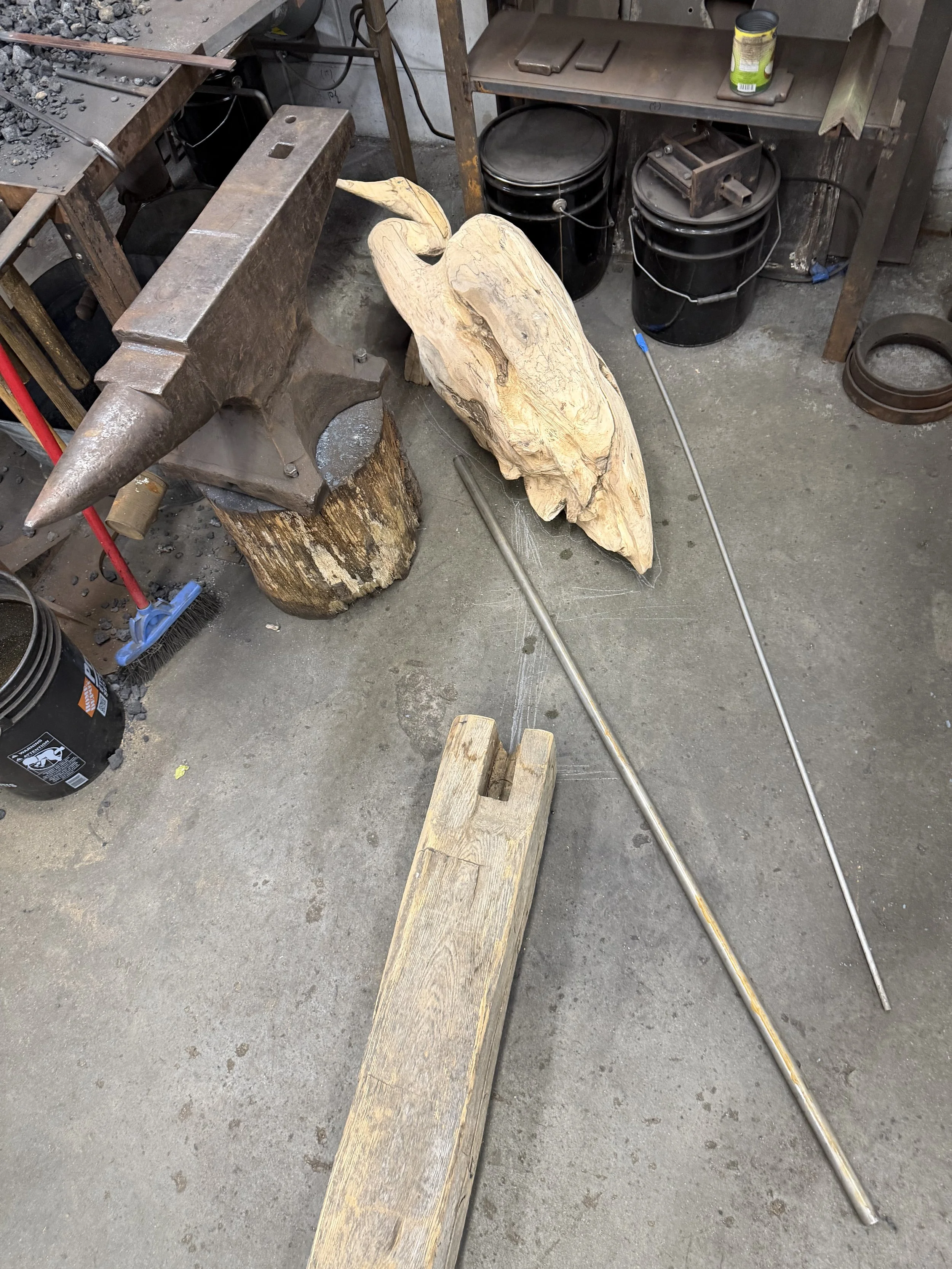
I had initially underestimated the complexity of constructing the legs. I figured I could source some stainless steel and, with a little ingenuity, shape it into something resembling the anatomy of a bird.
As is often the case with my artistic endeavours, things escalated rather quickly.
I reached out to my former blacksmithing instructor from my days at the Haliburton School of Art + Design, who generously welcomed me into her studio. What was intended to be one day of blacksmithing turned into two.
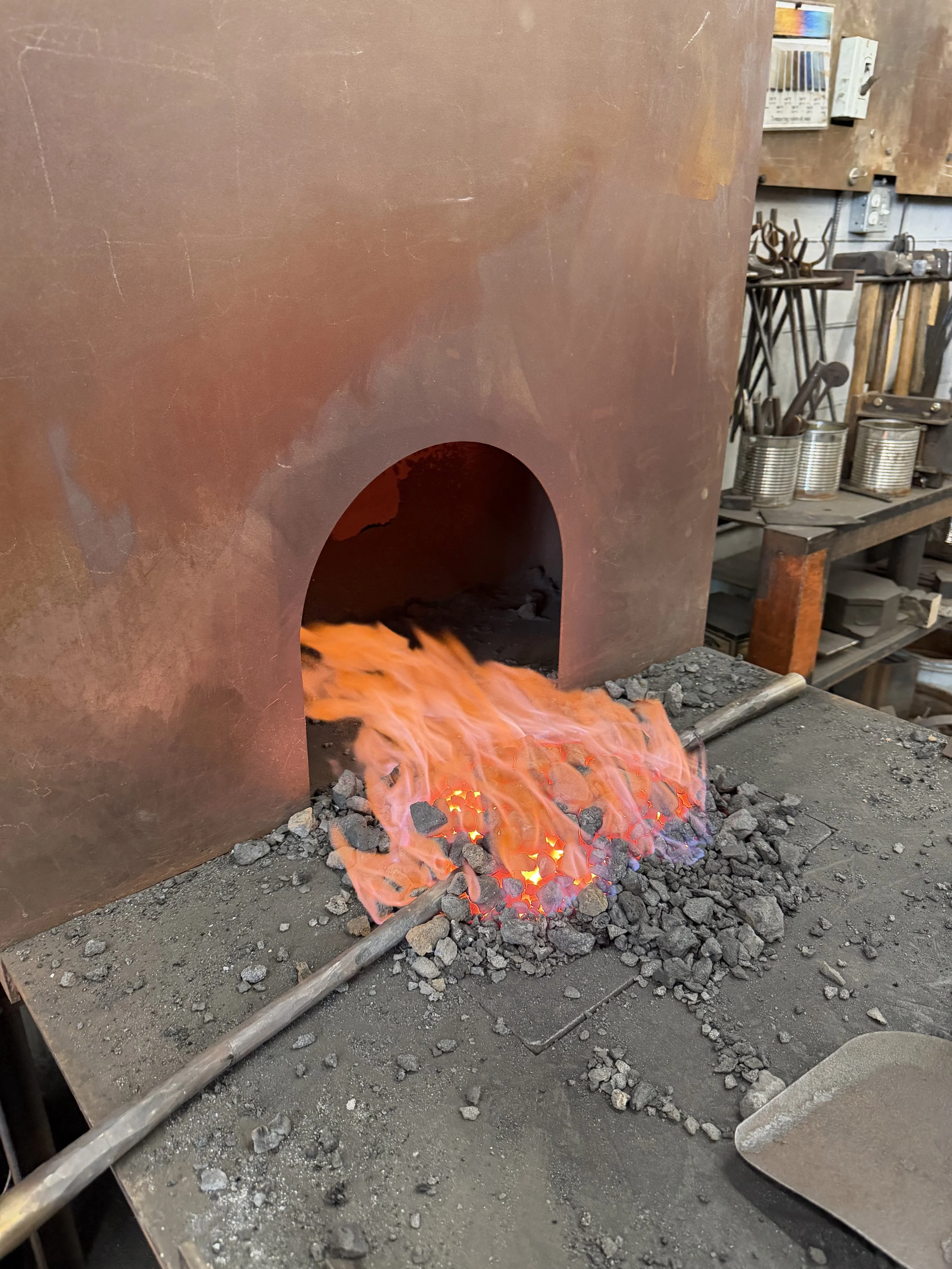
Working with a coal forge, a pneumatic power hammer and some rather ambitious lengths of stainless steel, I found myself revisiting skills I hadn’t put to use in quite some time. Those two days were invaluable, filled with shared knowledge, problem-solving and a renewed appreciation for the craft of blacksmithing.
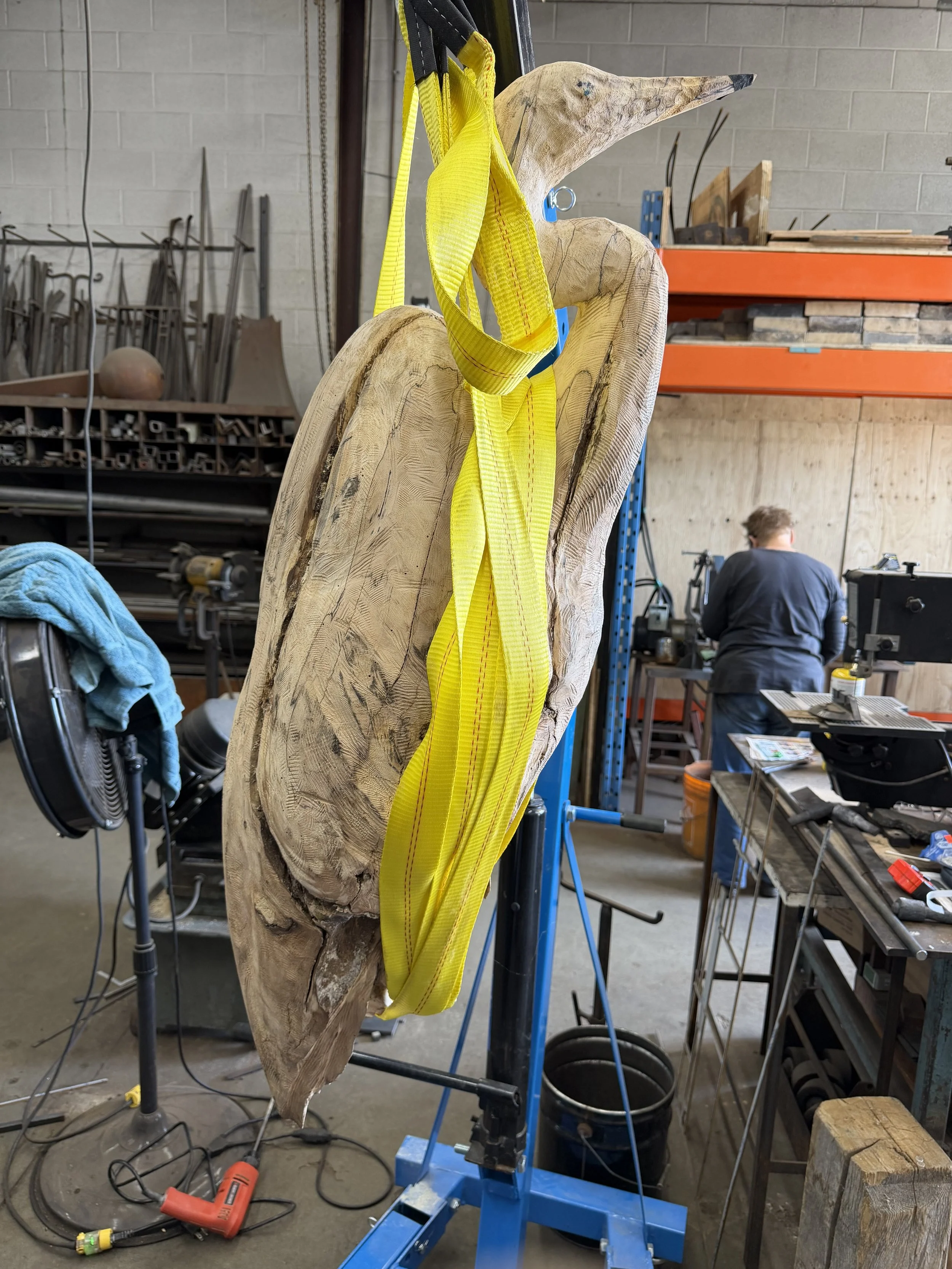
Back in my own studio, an engine hoist became an unlikely addition to my sculpting tools as I worked to position the body and accurately mount the legs.
I even managed to install the reclaimed wood base backwards at one point. After a good laugh at my own expense and a little head-scratching, everything was turned around, and to my relief, the bird stood beautifully balanced.
It was finally finding its footing.
An Unexpected Encounter
The timing of the blacksmithing phase coincided nicely with a live carving demonstration I was doing outside the Upper Canada Native Art Gallery in Niagara-on-the-Lake.
I always enjoy these opportunities. Working outside the confines of my dusty studio, engaging in conversations with passersby and hearing their stories brings another dimension to the creative process.
I was also rather amused to discover that I had apparently earned the reputation of being the owl guy among some of the gallery’s visitors.
It was during this demonstration that I was introduced to Lisa Elliott.
We struck up a conversation about herons and egrets, sharing our observations and experiences with these remarkable birds. At the time, I was already contemplating a transition from the original Great Egret to a Great Blue Heron, as the proportions of the emerging sculpture seemed to lend themselves more naturally to the latter.
Lisa expressed a connection to the work, and I happily agreed to keep her updated as it progressed.
I later learned that she had been considering it as a gift for her husband, wildlife artist Edward Spera, whose work I’ve admired for quite some time.
Beyond his extraordinary paintings, I’ve always appreciated Edward’s dedication to experiencing wildlife firsthand, travelling to observe and photograph his subjects in their natural environments. There is a level of authenticity in that approach that I greatly admire and aspire to explore further within my own artistic practice.
Our encounter that afternoon gave the sculpture’s journey a rather unexpected direction.
The Art of Patience
The transition from an egret to a heron was more involved than I had anticipated.
Soft sections of wood in particularly sensitive areas required reinforcement, the beak was strengthened internally with brass, and various sculptural techniques were combined to compensate for the limitations of the original material.
There were admittedly a few moments while refining the contours of the feathers when I thought to myself that it might have been easier to carve the entire thing out of stone.
But stone could never replicate the intricate grain, knots and natural imperfections that gave this particular piece its character.
The final stages involved subtle airbrushing and acrylic detailing, establishing the distinctive colours of the Great Blue Heron while allowing the natural wood to remain an integral part of the composition.
What began as a project I had hoped to complete by the end of summer carried well into November. But as the work evolved, so did the standards I had set for it.
Perhaps there was something fitting about learning patience while sculpting a creature that has mastered the art of it.
A heron can stand motionless for an extraordinary length of time, waiting for precisely the right moment to act. There is an intention behind its stillness that I’ve come to appreciate even more through the creation of this piece.
Where It Was Meant to Be
When I finally reached out to Lisa to let her know the sculpture was complete, I discovered that, quite unknowingly, I had finished it just in time for her and Edward’s anniversary.
Somehow, despite all the delays, technical hurdles and unexpected turns, the timing couldn’t have been better.
After showing Lisa the completed sculpture, I had the pleasure of delivering it to Edward that same afternoon as a surprise.
What followed was one of those experiences that makes all the long hours in the studio worthwhile.
We shared stories of our experiences with herons, and hearing about the connection that Lisa and Edward have formed with these birds over the years made the occasion all the more meaningful.
Edward was also generous in sharing some of his experiences and advice as an artist. These are the sorts of conversations I treasure — the opportunity to exchange ideas, learn from someone further along in their artistic journey, and carry a little of that wisdom forward into my own.
It is a wonderful feeling to know that a work you’ve invested so much of yourself into has found a home where its subject holds such genuine meaning.
Finding My Own Wings
Admittedly, I still feel a little like a fledgling trying to find its wings.
Balancing life as a father, a husband, a full-time assembly-line worker at Toyota and an artist is an ongoing challenge. The artist in me rarely switches off, and my thoughts have a tendency to wander back into the studio, even when I’m nowhere near it.
Making the leap towards a life more devoted to art is something I aspire to. For now, I’m learning to make smaller, more deliberate leaps whenever the opportunity presents itself.
Experiences like this one serve as a reminder of why I continue to make them.
I’ve also come to appreciate the strange synchronicities that occasionally present themselves throughout life. Whether you attribute them to God, the universe, the Creator, or simply the beautiful unpredictability of life, there are moments when seemingly unrelated events come together in ways that are difficult not to appreciate.
A discarded tree trunk, a stranger on the side of the road, a former teacher, a carving demonstration, a chance encounter and an anniversary I knew nothing about.
None of it could have been planned quite so well.
My sincere gratitude goes out to Lisa and Edward for allowing me to be a small part of their story, and to everyone whose hands, knowledge and kindness contributed to this journey along the way.
Two years ago, a piece of wood was lying at the side of the road, its purpose seemingly exhausted.
Today, it stands quietly in its new home. Standing in front of a window, gazing at the waters, keeping watch.
And perhaps, after all this time, Stillness has found exactly where it was meant to be.
Forging the Legs of a Blue Heron
The heron still has a long way to go. There is carving left to do, feet to shape, steel to finish, colour to build and water to create.
About four weeks ago, I made the trip to a blacksmith shop to tackle an unusual part of a sculpture that has been occupying my studio for quite some time: the legs for a large blue heron carved from spalted maple.
This piece began sometime last winter and has been a particularly meaningful project for me. It is the first sculpture where I started with a chainsaw and gradually worked my way down through smaller and smaller tools, slowly revealing the form hidden within the wood. After months of carving, I had finally reached the point where I could begin to feel a real sense of accomplishment.
The legs, however, presented a problem.
I hadn’t done any serious blacksmithing since 2004, when I studied the craft at the Haliburton School of Art and Design. Fortunately, I have the good fortune of knowing someone who could help me get back into it: Sandra Dunn, who runs the blacksmith shop I visited—and, somewhat ironically, was also one of my teachers all those years ago.
It was a wonderful opportunity to return to the forge with someone who had originally taught me the craft.
We fired up the coal forge and selected the stock for the legs: one-inch stainless-steel rods. Sandra also generously let me make use of her pneumatic hammer, which made the work considerably faster than it would have been by hand.
Even so, the stainless steel was a completely different beast from the wrought iron I remembered working with. It was incredibly hard and required a tremendous amount of effort to move. What I had imagined would be a roughly five-hour job quickly became something closer to a two-day undertaking.
And, naturally, I managed to make things a little more complicated.
At one point on the first day, I left one of the pieces in the forge a little too long and managed to disintegrate part of the leg. Thankfully, Sandra and her crew were able to weld it back together. The repair disappeared remarkably well—once finished, you would never know the leg had been broken in half, and the joint is structurally sound.
After all that forging, the next challenge was figuring out how to actually mount this enormous bird.
The wooden sculpture stands roughly three and a half feet tall, so I used an engine hoist to lift the piece into the air while I carefully located and drilled the mounting holes through both the reclaimed wood base and the heron itself. Getting the angles right took some patience and careful attention to detail, but eventually everything came together.
And then came the moment I had been waiting for.
The heron stood on its own.
For a sculpture this large, though, simply standing isn’t quite enough. I need to be able to continue carving without worrying about the whole thing shifting or tipping, so I also had Sandra help me fabricate a steel support hidden within the reclaimed wood base.
Three half-inch wrought-iron rods will disappear into the base and connect the sculpture securely to the bottom. The intention is that none of this structure will be visible when the piece is finished. Instead, the base will create the illusion that the heron is standing in shallow water, with its legs disappearing naturally into the surface.
There is still quite a bit of work ahead.
I’ll carve the heron’s feet directly from wood and paint them to blend with the stainless-steel legs. The legs themselves will receive a dark, black-grey finish that transitions naturally into the feet and the colours of the bird.
Once the carving is complete, the heron will be painted with a gradient inspired by the natural tones of a blue heron—richer colour toward the upper portion of the bird while leaving the lower portion closer to the natural warmth of the maple.
The final touch will be the base.
I plan to use a river-flow epoxy over the stainless-steel support so that the structure disappears beneath a translucent, water-like surface. The goal is for the finished sculpture to give the impression of a blue heron standing in water, while still allowing the character and grain of the reclaimed wood to remain part of the piece.
It is a big project.
But that’s often the way these things happen. You start with an idea that seems manageable, and somewhere along the way it becomes considerably more complicated than you anticipated. Then, once you’ve invested enough time into it, you can’t really stop. You just keep following the piece toward whatever it wants to become.
Interestingly, this sculpture wasn’t originally intended to be a blue heron at all.
I began it as a great egret. Somewhere well into the carving process, however, I realized that the height and proportions of the sculpture had grown beyond what would make sense for a great egret. Rather than forcing the sculpture to conform to the original idea, I decided to let the piece become what its proportions were suggesting.
The blue heron made much more sense.
Sometimes the material has a better idea than the artist.
There is another reason I’ve had the opportunity to make so much progress on this piece lately.
My stone-carving course at the Haliburton School of Art and Design was unfortunately unable to run this year because we didn’t reach the minimum enrollment. It was disappointing, particularly because I really enjoy returning to Haliburton and introducing people to the craft of stone carving.
The timing would have been ideal, too. The course was scheduled for mid-August, when the temperatures are generally a little more forgiving than they can be in June or July. Since the course takes place outdoors in a tent, cooler weather makes a considerable difference.
But that’s the nature of teaching and scheduling. Sometimes a particular week simply doesn’t line up with enough people’s vacation plans.
Hopefully the course will have another chance to run next year. I would love to return and share the process of taking an idea from a rough piece of material and gradually turning it into something tangible.
In the meantime, perhaps everything happened for a reason.
The cancelled course gave me a little unexpected time to return to this heron and push the project further than I otherwise might have.
So, for now, I’m enjoying the process and looking forward to seeing where it leads.
There is still plenty of carving, forging, drilling, painting and finishing ahead before this bird is ready to leave the studio. I’ll share more photographs and progress as the sculpture continues to take shape.
For now, at least, the heron has legs—and it can finally stand on its own.