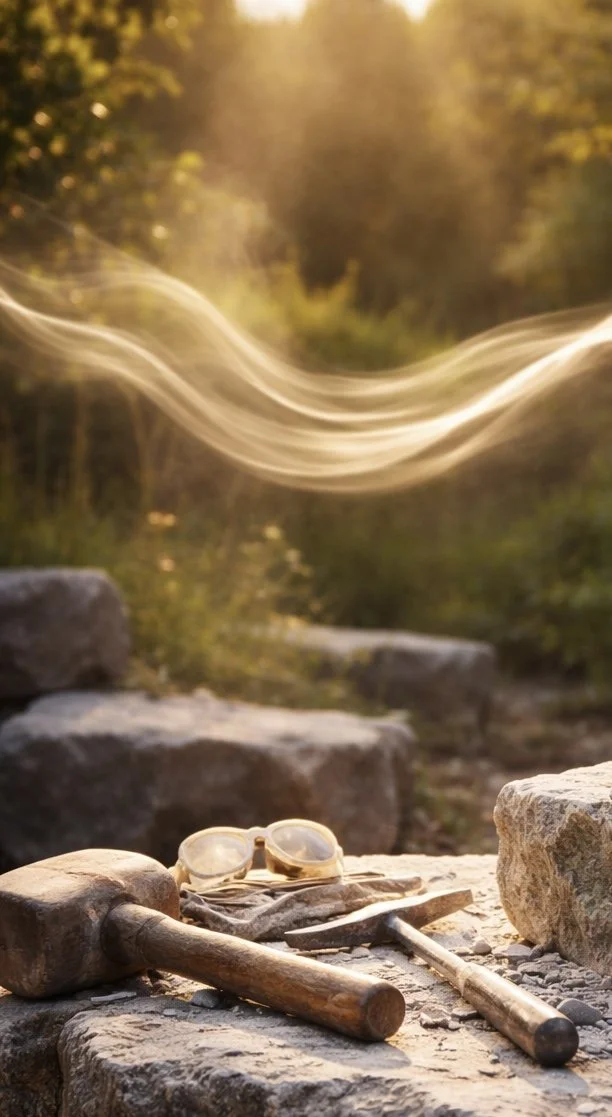
From Vision to Form: Time, Stone, and the Quantum Wave
Today I found myself perplexed again by the Double-Slit Experiment — one of the most fascinating and mind-bending discoveries in modern physics — and how it relate to how we understand reality itself.
In this experiment, particles behave differently depending on whether they are observed. When unobserved, they appear as waves of possibility, interacting and overlapping. When measured, they appear as fixed points, individual particles, as though each moment becomes defined only when we look at it.
This raises a profound idea:
Are events truly separate and fixed, or are they connected in ways we only recognize when we step back and observe the whole?
We often think of our lives as linear — moments passing one by one, like particles flying through time. Each day, each action, each decision feels isolated. But the deeper we look, the more it seems these moments are not separate at all. They influence one another, overlap, and interact, forming something more like a wave across time.
Even more puzzling, variations of the quantum slit experiment — like the Delayed Choice Quantum Eraser Experiment — suggest that decisions made in the future can appear to influence outcomes in the present. While physicists still debate the interpretation, the metaphor is powerful.
It invites us to consider:
Who we decide to become in the future may shape who we are today.
The artist we envision becoming tomorrow quietly influences the decisions we make now — the stones we choose, the ideas we pursue, the patience we develop. The future begins to pull us forward, shaping the present before the work even exists.
Stone Carving as a Wave Through Time
What I love about stone carving is that it is a slow progression toward form.
Often, it takes careful planning to ensure the sculpture arrives without distortion. Yet despite the planning, the form rarely appears all at once. It emerges gradually, almost like a soft wave taking shape. This process has always reminded me of the wave-like patterns seen in the double-slit experiment — subtle, layered, and evolving.
The tool becomes a guide, helping to find the natural lines that reveal themselves once the anatomy of the subject begins to emerge. Each pass of the chisel removes a small fragment, a tiny moment of time embedded into the stone.
Day by day, the process can appear slow — even tiring to watch. A little here. A little there. Like individual particles passing through the doors of perception.
But outside of time, all of those days begin to blend together.
At the end, the sculpture emerges as a whole — not as thousands of small actions, but as a unified presence. What once appeared as separate moments becomes a single wave, a complete form.
The viewer does not see the individual strikes of the tool.
They see the result.
And in that moment, all the lost days, the dust, the effort, and the careful decisions collapse into a single experience — a piece of time fused into form.
A Piece of Time, Held in Stone
The beauty of sculpture is that it becomes a record of time, but not in a linear way. Instead, it becomes something closer to a memory — or even a wave — where past, present, and intention all converge into a fixed moment.
Each sculpture becomes:
A parable
A story
A moment relived in a personal way
The viewer observes the present form, yet experiences echoes of the past and possibilities for the future.
For this reason, I titled my summer course:
Stone Carving: From Vision to Form
Because this process is often elusive. The vision is not always clear at the beginning. Sometimes it emerges slowly. Sometimes it is shaped by careful planning. Sometimes it feels as though the piece was decided in the future and gradually found its way into the present.
But when it arrives, it is always beautiful in its own way.
Like a wave collapsing into form.
Like time, held in stone.