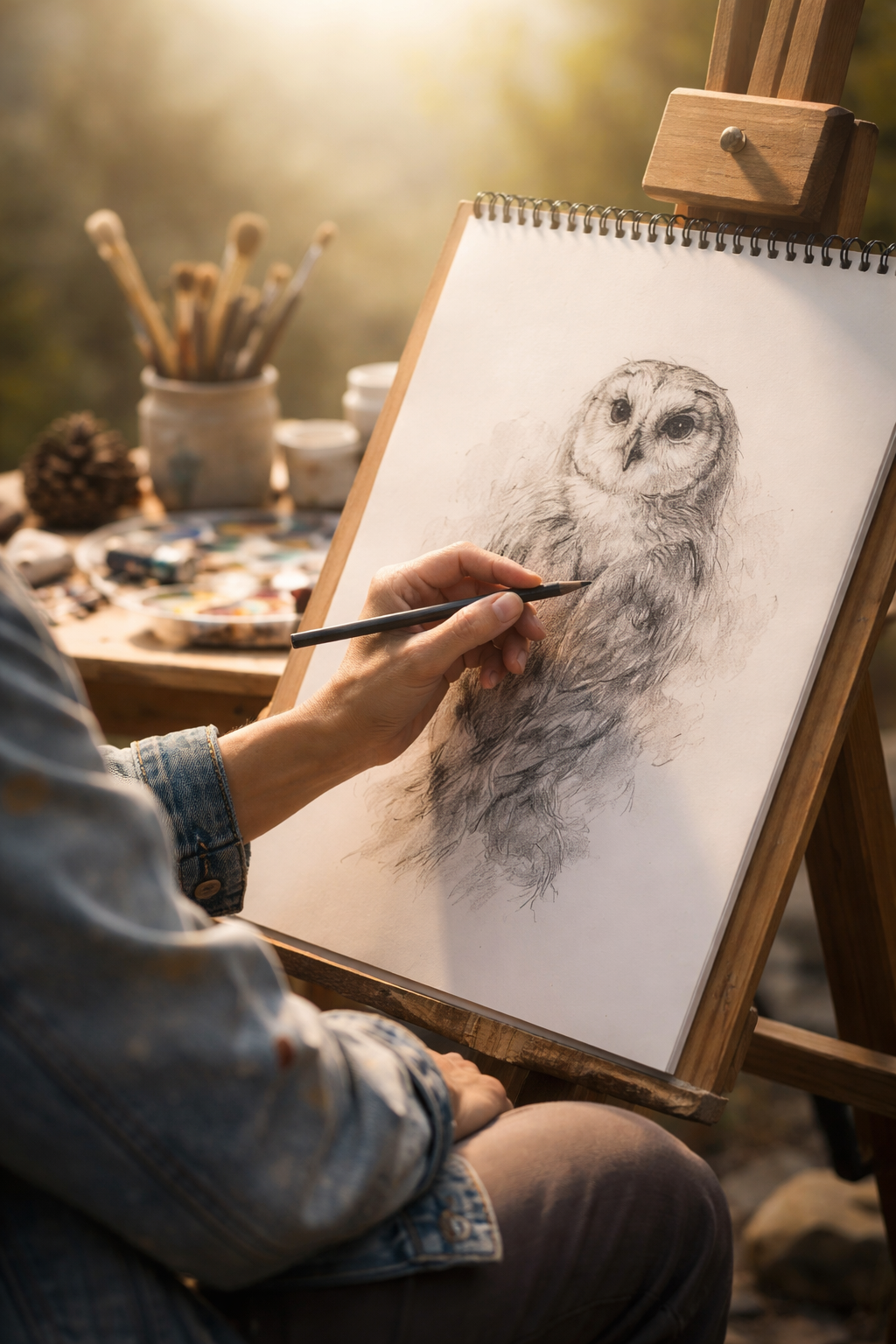
Learning to See for Yourself
David Hockney once said in an interview:
“I think a lot of people would like to be artists. What you’re doing is interpreting life. You’re interpreting your experience, and it’s a privilege in a sense to be able to do that.”
I believe this is profoundly true. Awakening to the ability to see the world — and then recreate that reality through your own hands — is a gift worth cherishing. There is so much in this life that needs to be learned, taught, and passed along, and each of us does this in a way as unique as our own personality. The way you see is not a flaw. It is perfect in its own way.
Anyone who has spent time in an art class knows this instinctively. Place a group of people in front of the same reference image, give them the same medium, and ask them to copy what they see. The results will always be wonderfully different. Yes, skill levels vary — but that’s not the point. What matters is that each person is learning how they observe, interpret, and project what they see. Every attempt deepens perception. Every repetition refines understanding. Growth happens not through imitation alone, but through honest self-reflection layered into the process.
What troubles me about much of contemporary art culture — especially in art schools and viral platforms — is the growing admiration for what I’d call effortless spectacle. Work that requires little time, little discipline, and little practical investment, yet thrives on flashy presentation and algorithmic manipulation. Attention becomes currency. Funding follows clicks. Eventually, the work itself becomes secondary to the performance around it.
At some point, it no longer matters whether the artist has depth or skill — only that they appear important. Prices inflate like speculative assets, untethered from meaning, until repetition alone cements their place in textbooks. The system validates itself.
And here’s the uncomfortable truth: sometimes we need to call it out.
If a piece of art doesn’t resonate after an honest, patient attempt to understand it — if it fails to speak in any meaningful way — it’s possible you’re not missing something. It’s possible you’ve been duped. When art requires a tour guide, a manifesto, or relentless self-promotion just to justify its existence, it may be the surrounding noise doing the heavy lifting — not the work itself.
Your attention is valuable. You don’t owe it to the algorithm. You don’t owe it to trends. You don’t owe it to charisma, bravado, or carefully curated personas. Too often, the art becomes inseparable from the figure behind it, and the object itself loses its voice.
The antidote to this isn’t cynicism — it’s practice.
Learning to make art for yourself, in your own way, is one of the most awakening acts you can undertake. It teaches you how to see clearly. It sharpens discernment. It reconnects you to what feels honest and alive. Creating isn’t about chasing recognition — it’s about becoming the thing you once wished existed.
Learn to see for yourself.
Create for yourself.
That’s where meaning still lives.