
Something Unique
What happens when an original stone sculpture crosses into another medium? Through 3D scanning, digital modelling, and a combination of materials, Wesley Booker explores a new sculptural process he calls Veritas Composite.
I suppose everyone is looking for something exceptional. Something that has never quite been done before. Something that makes people stop for a moment and wonder how it came into existence.
And I think, perhaps, I have found a little bit of that.
In my studio, I am constantly imagining new ways of getting things done. Stone carving has slowly moulded me into something of a jack-of-a-few-trades. Over the years, I have learned to move between materials, tools, and technologies—sometimes because I want to, and sometimes because the work itself seems to demand it.
Recently, I have been exploring 3D scanning and digital modelling as part of my sculptural process. But the goal is not to abandon the original material. Quite the opposite. The goal is to carry something forward.
A sculpture begins in stone. It is carved, discovered, and brought into being through the removal of material. Then, through a combination of scanning, modelling, and casting, it can pass into another medium entirely. The strange thing is that the result often becomes so transformed that people cannot even recognize the original sculpture within it. And yet, somehow, it is still there.
This is not entirely unlike the process of bronze casting, where the original sculpture is often made from clay or another material before being transformed into bronze. But there is something different about beginning with stone. Stone is not simply a material that can be replaced. It has its own history. Its own weight. Its own ancientness.
So when a sculpture begins in stone and eventually becomes something else, the process becomes a kind of transformation. The original is not destroyed. It becomes something new.
I have begun calling these works Veritas Composite.
Veritas is Latin for “truth,” while composite refers to something made from several different materials. Together, the name seems to describe the process quite well. It is a simpler way of saying: a sculpture that began in stone and has been transformed through a combination of materials and modern techniques.
But perhaps there is something more truthful in the name than that. Because the work is not pretending to be one thing. It is stone. It is bronze-like. It is wood, brass, glass, and the invisible mathematics of digital scanning. It is an original sculpture, and it is also something entirely new.
Perhaps that is what makes it true.
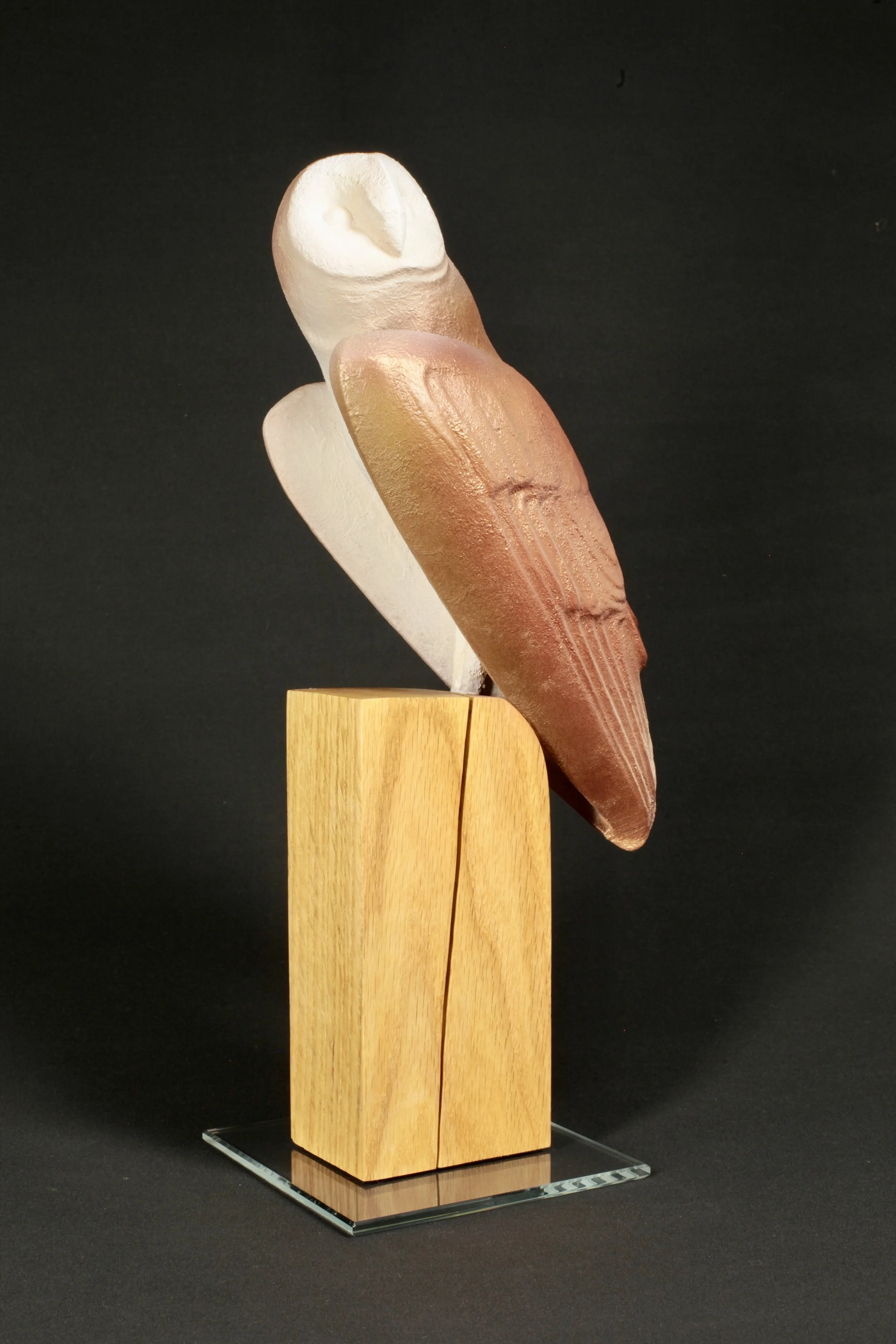
Tracing the Heavens
The first of these works is named, like its predecessor, Tracing the Heavens. The sculpture is mounted with brass dowels running through the work and into a cured piece of red oak. Beneath it, a glass base provides stability while allowing the sculpture to remain visually light.
There is something I enjoy about the meeting of these materials. The stone carries its ancient weight, while the brass and glass seem to lift it into something more contemporary. The red oak gives it a grounding—something warm and earthly.
Stone reaching upward. The heavens above. The earth below. A small meeting of worlds.
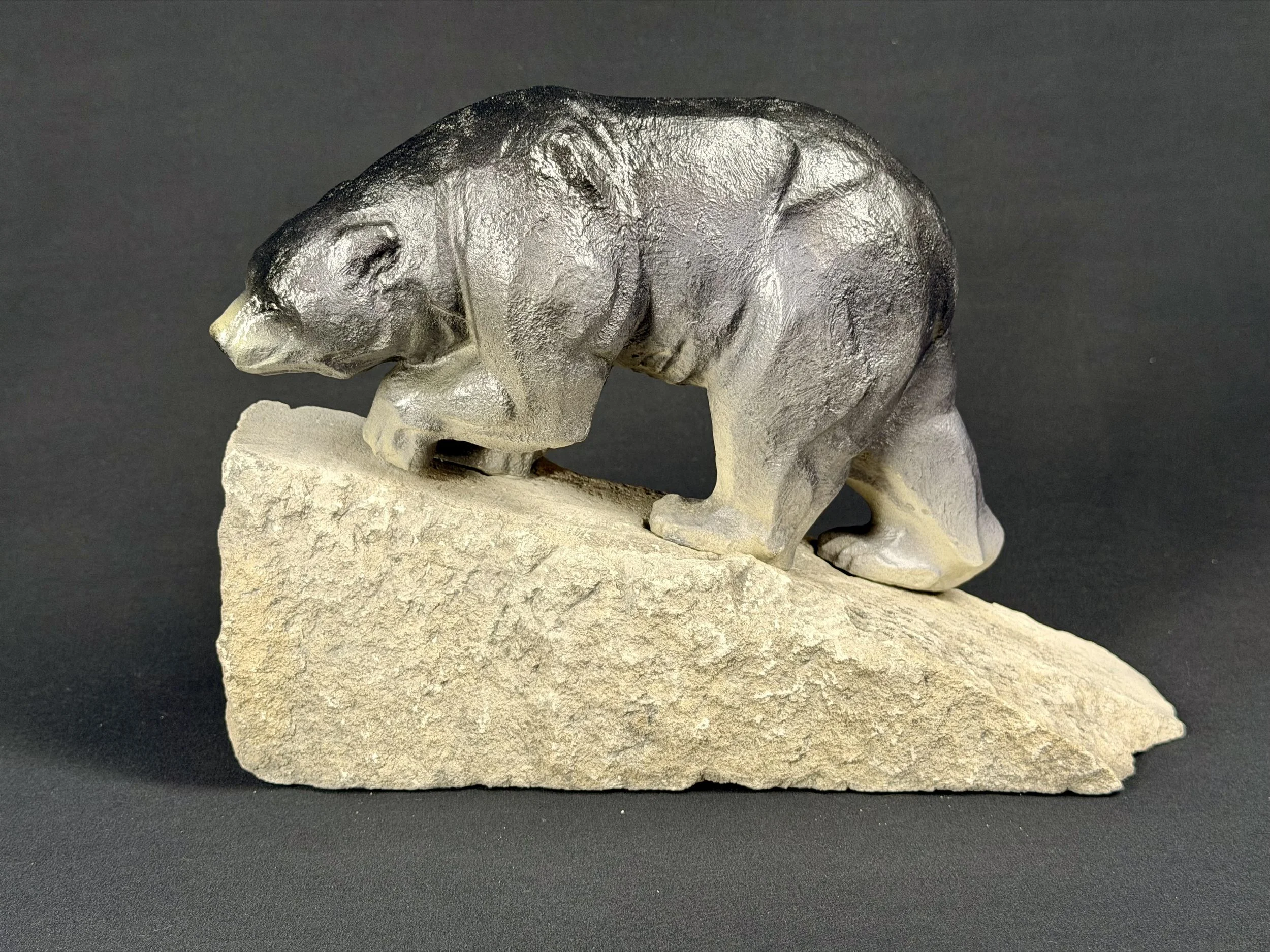
Requiem
The second work is called Requiem.
The word means “rest.”
I chose the name following a period in my own life last year when I was forced to rest after an illness that nearly took my life. There are certain experiences that change the way one looks at time. The things that once seemed urgent become strangely quiet. The body becomes a reminder that everything we are doing is temporary, and that sometimes the most important thing we can do is simply remain.
This black bear is mounted to a limestone base. The finish was designed to bring out the character of its movement, while also allowing the life of the stone to move upward through its feet and into the body. I wanted the bear to feel as though it had not simply been placed upon the stone, but had emerged from it.
As if the limestone remembered the bear. As if the animal had been waiting there all along.
The black bear’s stealth is something that deserves attention in these northern lands. It can become almost ghostlike when it does not want to be seen. There is an incredible power in that kind of presence—the ability to move through the forest almost entirely unnoticed.
A dark shape between the trees. A sound in the undergrowth. And then nothing.
Perhaps that is part of what I wanted to capture in Requiem: not simply the physical form of the bear, but the feeling of its passing through the world.
Both of these sculptures exist somewhere between stone and bronze. They carry qualities of both, while belonging entirely to neither.
And this is perhaps the most interesting part of the process.
Each piece will be completely unique unto itself. Although I can create another work from the same original sculpture, the process of casting, finishing, and combining materials means that no two pieces will ever be entirely identical. Each one will have its own surface, its own character, its own small history.
The sculpture changes as it travels. From stone. To digital form. To another material. And finally, into the world.
These works are now resting at La Belle Galerie in Quebec City.
If one of them speaks to you, or if you are interested in having another piece created through this process, feel free to reach out to me.
Perhaps there is another sculpture waiting to cross over.