
Veritas Composite: Building Beyond Stone
Over the past several years, I’ve been expanding my sculpture practice beyond traditional stone carving into 3D scanning, bronze casting, and now a new hybrid material system called Veritas Composite.
This last week and a half has been a rush into something only my wife fully knows about. All the technical details of how to approach each individual project have been carefully rehearsed in my head — variations of possibilities revisited daily as I work on the Lexus RX line at Toyota Motor Manufacturing Canada here in Cambridge, Ontario.
Over the last five years, I’ve likely contributed to building around 800,000 vehicles. The process is so deeply ingrained in muscle memory that it frees my mind to focus intently on other projects. That’s the goal — to develop another operation that can run fluently alongside my stone carving practice.
Let me put it lightly before revealing too much. Stone carving is a deeply methodical process. My last project reinforced that reality. Working with black chlorite stone — roughly a 2–3 on the Mohs hardness scale — is still demanding. Even with extensive tool use, there is no shortcut through the material. It resists speed. It demands time.
So I began developing something alongside it — something I’ve quietly committed half my efforts toward before even producing true prototypes.
In truth, this has been unfolding for over six years.
It began with experimenting in 3D scanning. Using LiDAR through my iPhone Pro, I started building digital versions of my sculptures. At the time, it felt revolutionary — but the process was crude. I spent hundreds of hours refining just a few models, cleaning scans, improving surfaces, and preparing them for use. Some of these were uploaded online so others could produce their own versions, allowing me to gather feedback and explore new directions.
Two years ago, I invested in a dedicated laptop and a higher-precision 3D scanning system. This newer technology dramatically improved accuracy, reducing cleanup time and allowing me to create far more refined digital replicas of my work.
Around that same time, I took a weekend to experiment with bronze casting — a hands-on introduction to the process. The sand-casting method I explored showed me both the potential and the limitations. While it gave me a foundational understanding, it also made clear that certain levels of detail require more advanced processes.
About a year ago, I began developing a relationship with a professional foundry experienced in detailed bronze work. Their process, including lost-wax casting using resin prints, opened the door to a level of precision I knew I wanted to pursue. I committed to producing my first collector edition bronze of one of my favorite pieces, “Brother.” The process is expensive, requiring significant upfront investment to build inventory, but it’s a step toward making the work more accessible while maintaining quality.
I’ve also connected with a respected foundry in Quebec, known for both small-batch artistry and scalable production methods. Their clarity and experience have given me confidence in exploring multiple directions within casting.
But this all led to something unexpected.
Over time, I began developing my own material process — a hybrid approach combining organic materials, epoxy resins, clay-based applications, structural reinforcement, and layered finishing techniques like airbrushing and washes. Combined with my 3D scan library, this opens the door to creating entirely new works that maintain the spirit of stone, but expand beyond its limitations.
This evolving process has taken on a name:
Veritas Composite.
It’s not a single technique, but rather a flexible system. Sometimes it incorporates glass. Sometimes wire. Sometimes it leans heavily on resin or texture. Each piece becomes its own exploration — unique, hands-on, and far less constrained by the physical resistance of stone.
This direction came into sharper focus after a conversation with Eduard Spera at his gallery in Niagara-on-the-Lake. During our discussion, I asked whether my work might fit within his space. While it wasn’t the right time, his feedback was thoughtful and encouraging. He spoke about his own early years in printmaking beginning in 1991 — the successes, the failures, and the importance of evolving beyond one-off pieces.
One point stood out clearly: relying solely on individual, time-intensive works can limit how far your name travels. To grow, you need ways to expand your reach without sacrificing quality.
That conversation stayed with me.
So here I am, figuring it out.
Building something new. Expanding what’s possible. Finding ways to create work that maintains integrity while allowing it to exist more broadly in the world.
I hope this new venture works out. But to be honest, I’m still figuring it out as I go.
That’s part of the beauty of it.
Art isn’t a fixed path — it’s something shaped by your hands over time. It’s trial, error, intuition, and persistence. It’s identity formed through making.
There’s a quote often attributed to John Lennon that captures this spirit well:
“We’re all just making it up as we go along.”
And in many ways, that’s exactly what this is.
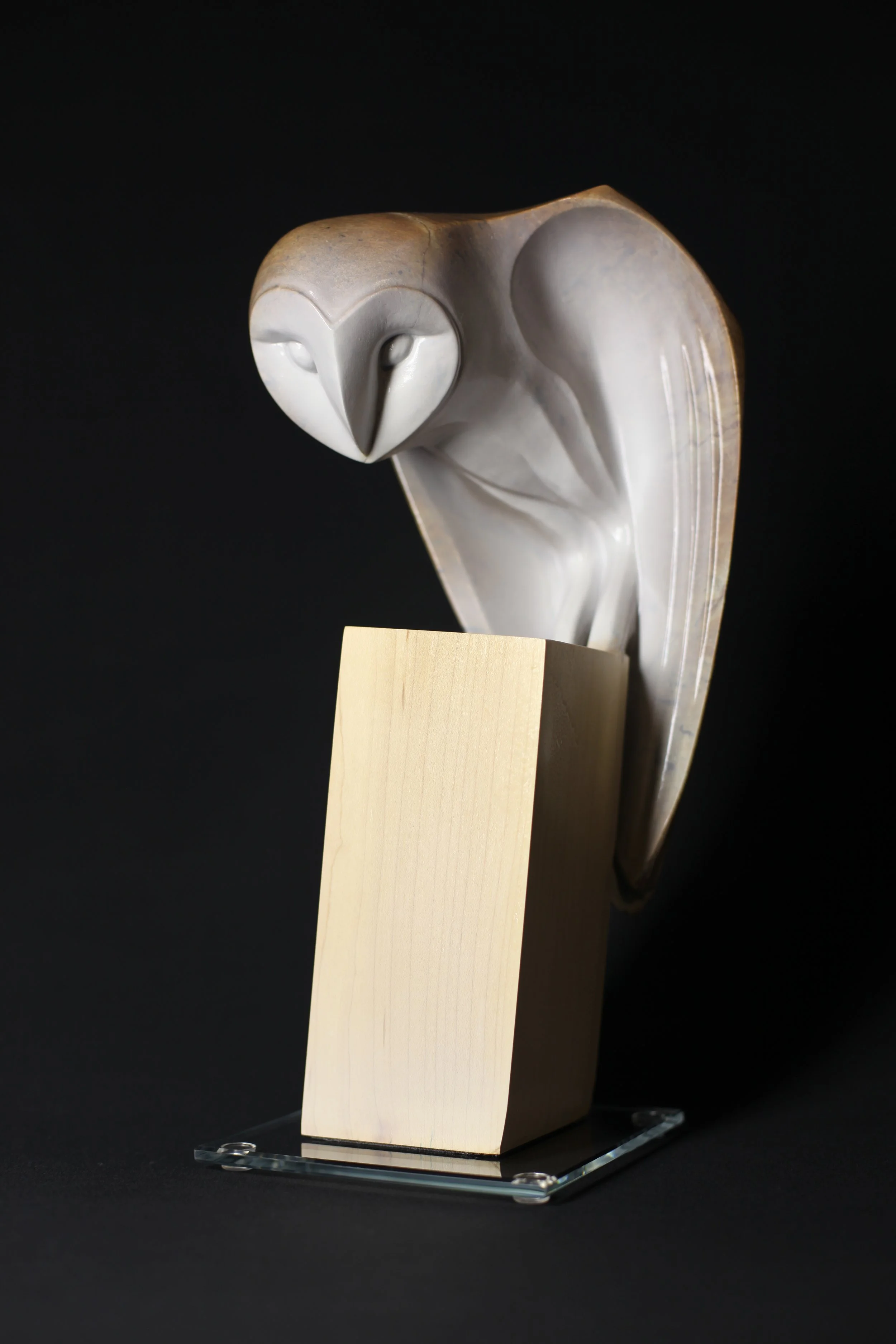
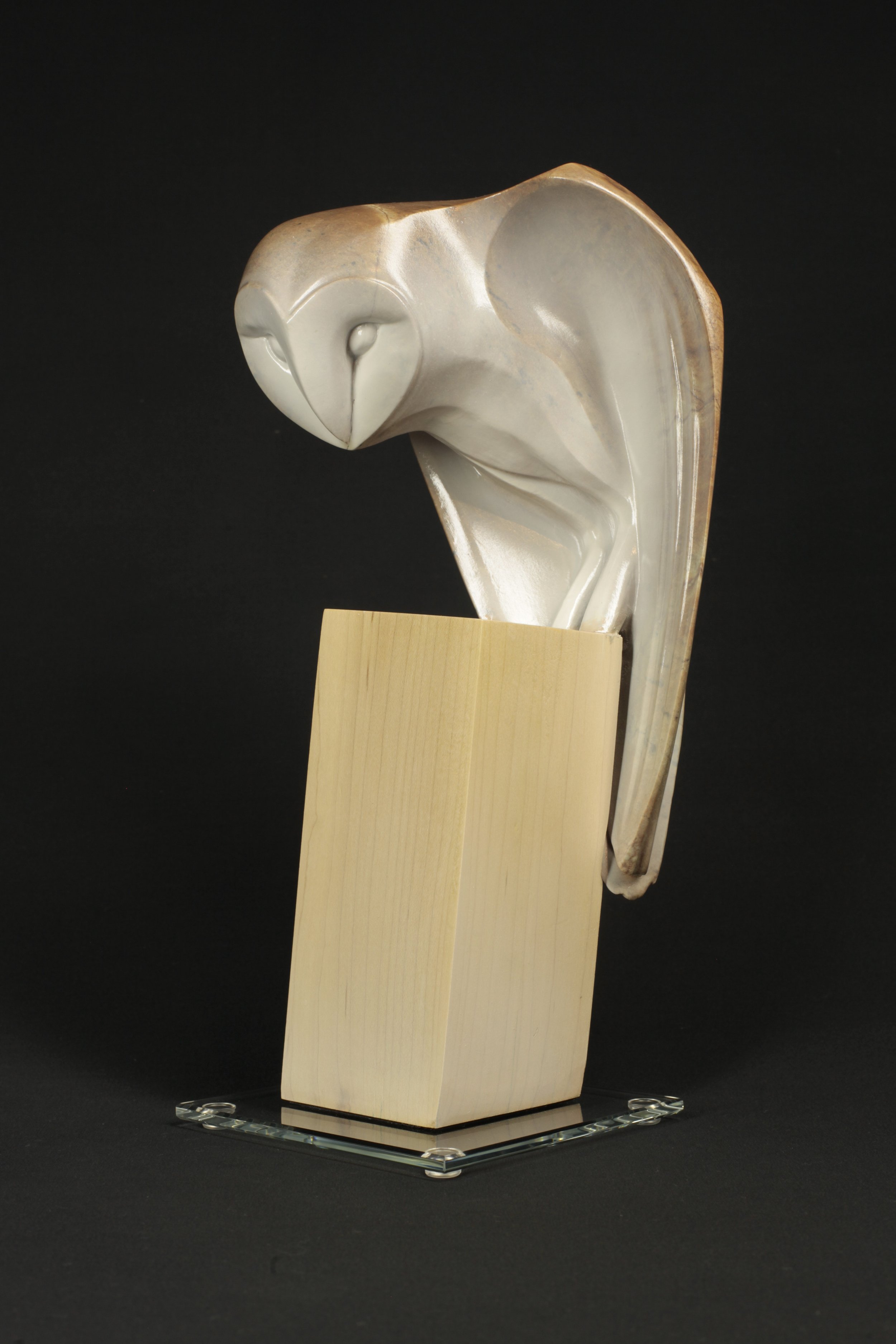
Learning All Over Again — Nocturnae & Clean Again
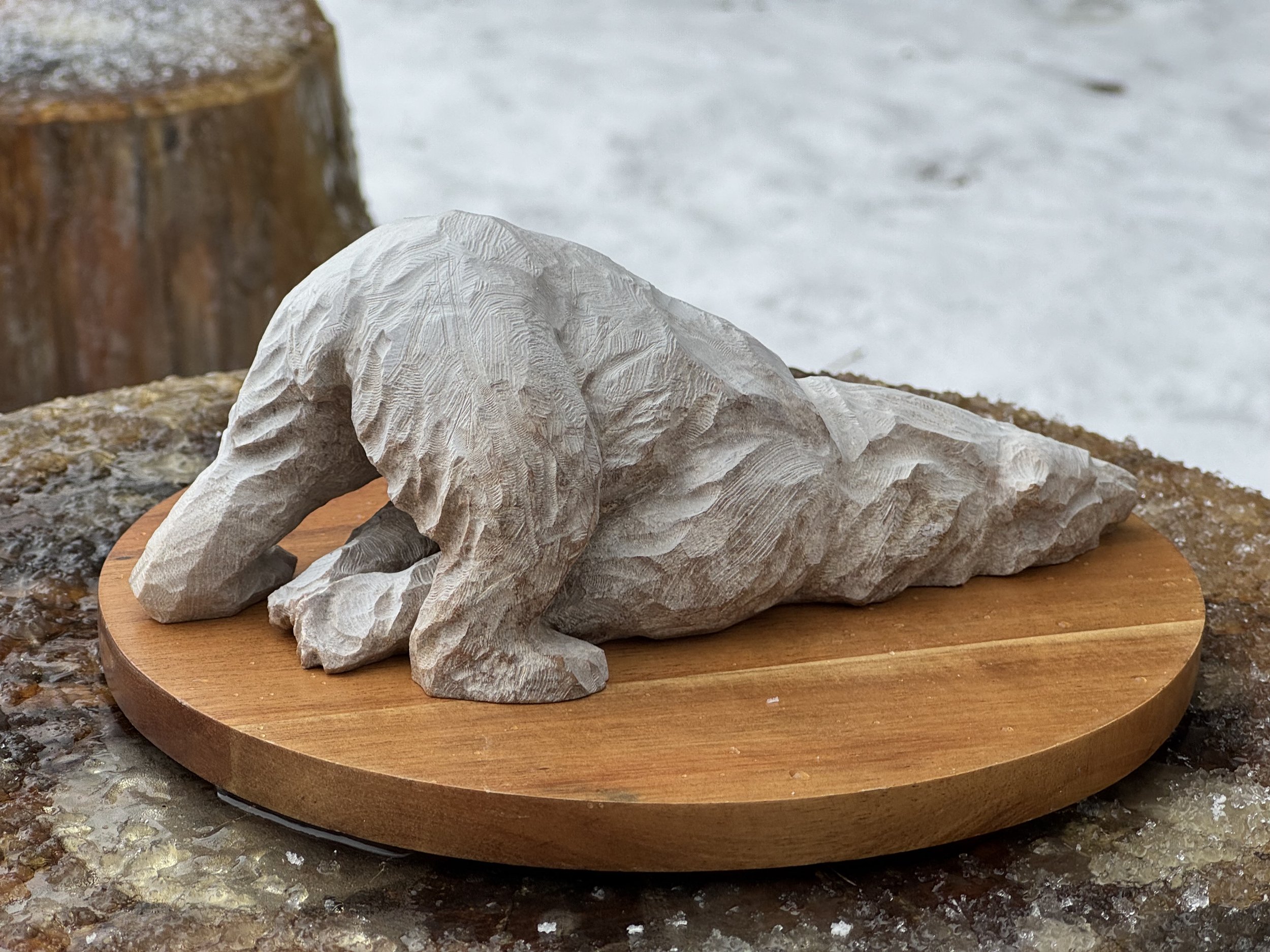
Each time I return to the owl or the bear, I begin again. Nocturnae and Clean Again explore two distinct personalities in stone — one watchful and nocturnal, the other instinctual and grounded. These sculptures reflect the slow process of learning to feel movement, muscle, feather, and fur from within the stone itself.
Each time I return to an owl or a bear, I’m learning all over again.
No two works of mine are much alike. Part of that is intentional — I leave space before approaching a subject again. I try not to repeat the same pose, the same lines, or even the same mistakes. That space forces me to approach the form as if it were brand new — living, dynamic, and deeply personal.
I’ve carved several owls and bears, as you may have noticed. But these last two feel different. They feel more real to me — not necessarily because they are “better,” but because they carry more life. They speak a little louder when viewed.
I know there is still a long way to go. Not in the sense of making a better sculpture, but in learning to truly feel the life of the barn owl or the polar bear — to carve as if it were my own body. To understand every joint and muscle, every fold of feather or sweep of fur. To sense how they move. How they rest. Even how they might feel.
Growth as an artist is slow and patient. Each day is unique. Allowing the process to unfold in its own time is paramount.
Nocturnae
The word Nocturnae means “belonging to the night.” After long night shifts spent carving, I sometimes feel nocturnal myself.
This piece took years of quiet deliberation. The stone sat for a long time before it revealed itself. When it finally did, it wasn’t obvious or graceful — it showed itself crudely, almost stubbornly. I wish I had a photograph of its original state. You’d be surprised it’s the same work.
But that’s part of being an artist. You gaze into stone the way you might gaze into the stars — until a shape begins to emerge from the chaos of constellations.
The owl, in my mind, is deeply observant. Fused in stillness. Perched high on a rafter or doorframe, trying not to be seen, yet fully aware. It locks its gaze onto someone below, quietly contemplating their thoughts and feelings. There is tension in that stillness — a presence that feels almost psychological.
Clean Again
Where the owl holds silence, the bear carries gesture.
The pose may look playful or even lazy — the slow shuffle after a long day, hindquarters raised, sliding forward to spare a few calories. It’s open to interpretation.
But in truth, the bear is cleaning its fur by dragging its body across the snow. Hence the name Clean Again. It’s a simple, instinctual act. A reset. A return to clarity.
What I love most about these two pieces is their personalities. They are distinct from one another, yet both feel alive in their own way.
Both Nocturnae and Clean Again are currently available and can be viewed in the Available Works section of my website. I invite you to take a closer look — sometimes the life within a sculpture reveals itself more fully when you stand quietly in front of
From “Stuck” to Strides: Looking Back, Looking Ahead
Five years ago I couldn’t have imagined where I’d be — and now I’ve carved, sold, taught, and grown in ways that feel surreal. So here’s to the next five, with my sights set even higher.
There’s a certain dark humour in admitting I felt “stuck” when asked where I saw myself in five years. But sitting with that for a while made me realize — I’ve already moved miles beyond where I thought I’d be five years ago.
I’ve shown at a gallery in the stunning Old Port of Quebec City. I’ve carved live at events there and back home in Cambridge. My range has grown so much that my old website became obsolete — I had to build a new one just to keep up with the work. And I’ve sold more pieces than I can usually keep pace with.
Oh, and we added a new family member along the way. :)
So here’s to the next five years — and the next leap.
I’m setting my sights on a few new milestones:
• A larger studio space to carve and create across multiple mediums
• A stronger bronze portfolio
• Representation in a Toronto gallery and one in the U.S.
• More teaching — especially at HSAD
• A public commission in a GTA city
That’s not too much to ask, right?
“Aim small, miss small” — but set the course. The rest follows. I’m putting it out there now: in five years, I’ll be an established name in the Canadian and American stone carving community. Bigger moves will come — but this is the foundation I’m laying now.
