
Looking Up: Lessons from an Owl and the Art of Letting Go
A reflection on carving, faith, and fatherhood—how one artist found spiritual meaning in a barn owl sculpture that reminded him of his daughter and the importance of looking up.
There are times I’ve fallen in love with a sculpture as I’ve been working on it. Perhaps I’m not the only one who’s felt this way—but for me, it’s increasingly rare. The constant inner critic is always present, whispering in the background, even as the artist within searches for appreciation and gratitude in the process. At some point, those two voices—the critic and the creator—merge. And in that merging, something magical happens: flow. The careful turns careless, the mind quiets, and the stone begins to speak.
The last piece I produced began with an extraordinary reference—a young barn owl, wings slightly spread, head raised toward the sky as if watching the heavens. The posture reminded me of my daughter. That innocent, upward gaze of wonder. How often do we forget to look up as we grow older? As we stand taller, we begin to see others as peers—or worse, as competition—each of us fighting never to look up again.
But maybe looking up is exactly what we need to do more often.
Our mission, whether as artists or simply as people, is to remain teachable—to learn from something higher, to serve others as if we were entertaining the children of God. To be both young and old at once requires humility and adaptability. It calls on us to forgive, to turn the cheek, and to love even our adversaries.
When I carve an owl, I often sense that same paradox: a creature both feared and revered. Its silent watchfulness commands respect, but in its eyes I see gentleness, understanding, and beauty. In this particular owl, I saw my daughter’s spirit—bright, alert, full of promise.
So when it came time to bring the sculpture to the gallery in Niagara-on-the-Lake, it wasn’t easy. Letting go never is. Yet, I know there will be more. I will see my daughter in many future works and strive to make each piece more beautiful than the last—for love’s sake, for the art, and for whoever the piece connects with. Because in the end, we’re all connected in ways we can’t yet imagine.
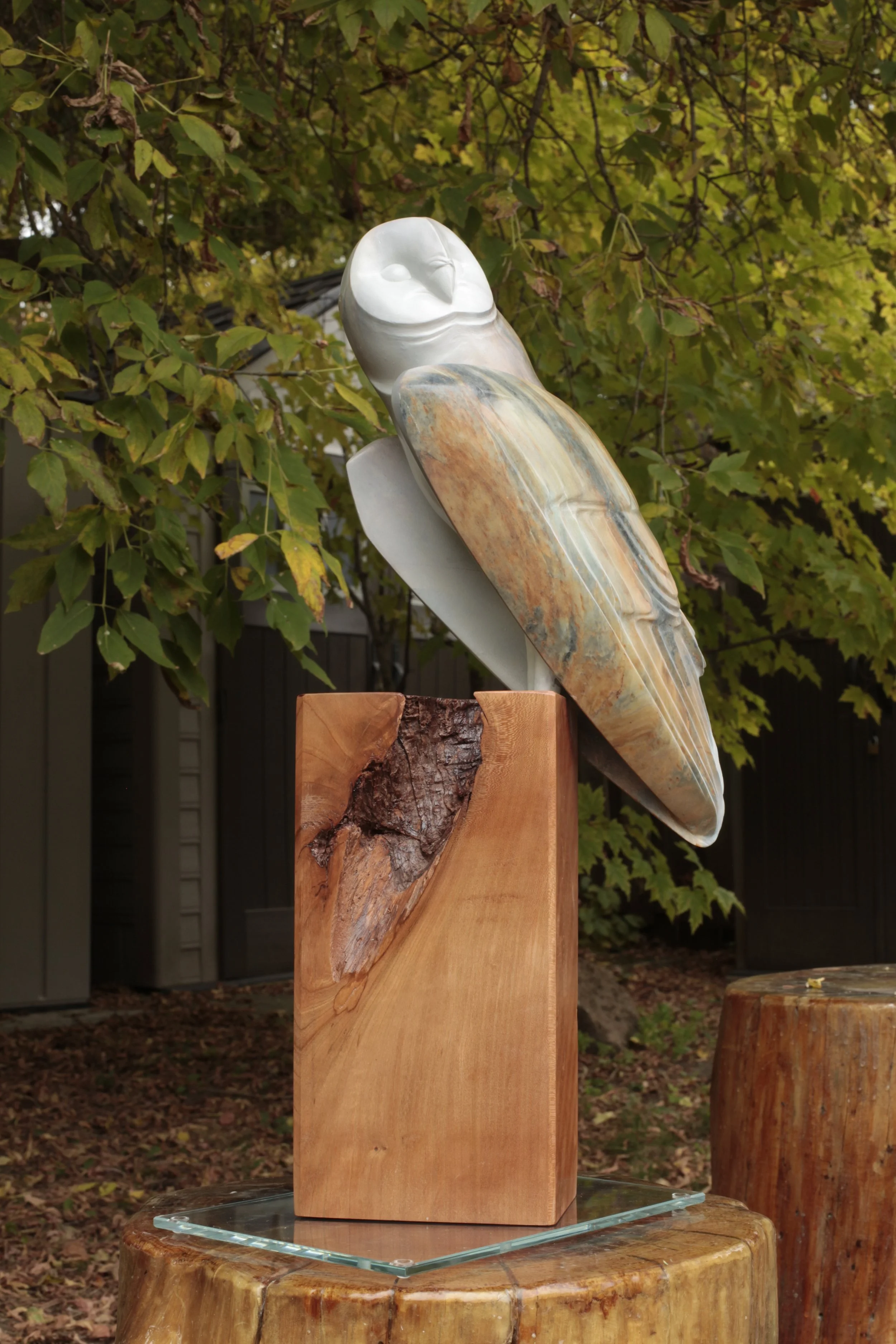
Tracing the Heavens – An Owl in Stone
A fractured stone, a cherry wood base, and an owl’s elegant pose came together in Tracing the Heavens. Follow the journey of this rare sculpture that named itself.
The thoughts and feelings that come with the artist’s life are important, but every so often I need to pause and reflect on the process itself—how a sculpture is actually made.
Recently, I’ve been immersed in a new piece that revealed its name to me long before I finished carving it. That’s a rare occurrence, and I take it as a sign that the motivation and meaning were already clear before the final details emerged.
The journey began about two months ago when I stumbled across a piece of stone from one of my two trusted stone dealers. It was an odd block—strangely colored with strong fracture lines running in different directions. For most carvers, that’s a definite “no.” Fractures can spell disaster, unless met with careful intention, planning, and a little luck. But I can’t resist a challenge, and I had already bought a similar stone just weeks earlier.
Around the same time, I came across a hollowed knot of cherry wood in a specialty wood shop. For $35, it seemed destined to become the base of one of my signature owls. The block sat waiting in my studio until, one day, I came across a photograph of an owl in an unusual pose—elegant, youthful, stretched upward. It reminded me of my daughter, and I knew instantly: this was the form I needed to carve.
To work out the posture, I sculpted a small plasticine model over 3.5 hours. From there, I scanned it using a lidar app on my phone and imported the model into a 3D program. Having a digital version I could rotate freely gave me a reliable reference alongside my sketches and collage of owl images.
Equipped with a new facemask, a 7” Makita grinder, fresh hand tools, and a custom carving table, I set to work in the studio. The first stage was intense—the grinder raising so much dust I could hardly see until it settled, even with my dust collection system running. Step by step, I shifted to finer burrs and cutters, slowly shaping the fragile stone into something true to the vision.
At this stage, I’m confident in the form, though there’s still a great deal of work ahead. What began as a discarded stone and a forgotten block of wood is taking shape as Tracing the Heavens—a sculpture whose name arrived before the carving was even halfway done.
I’ll share more as the owl emerges from the stone.