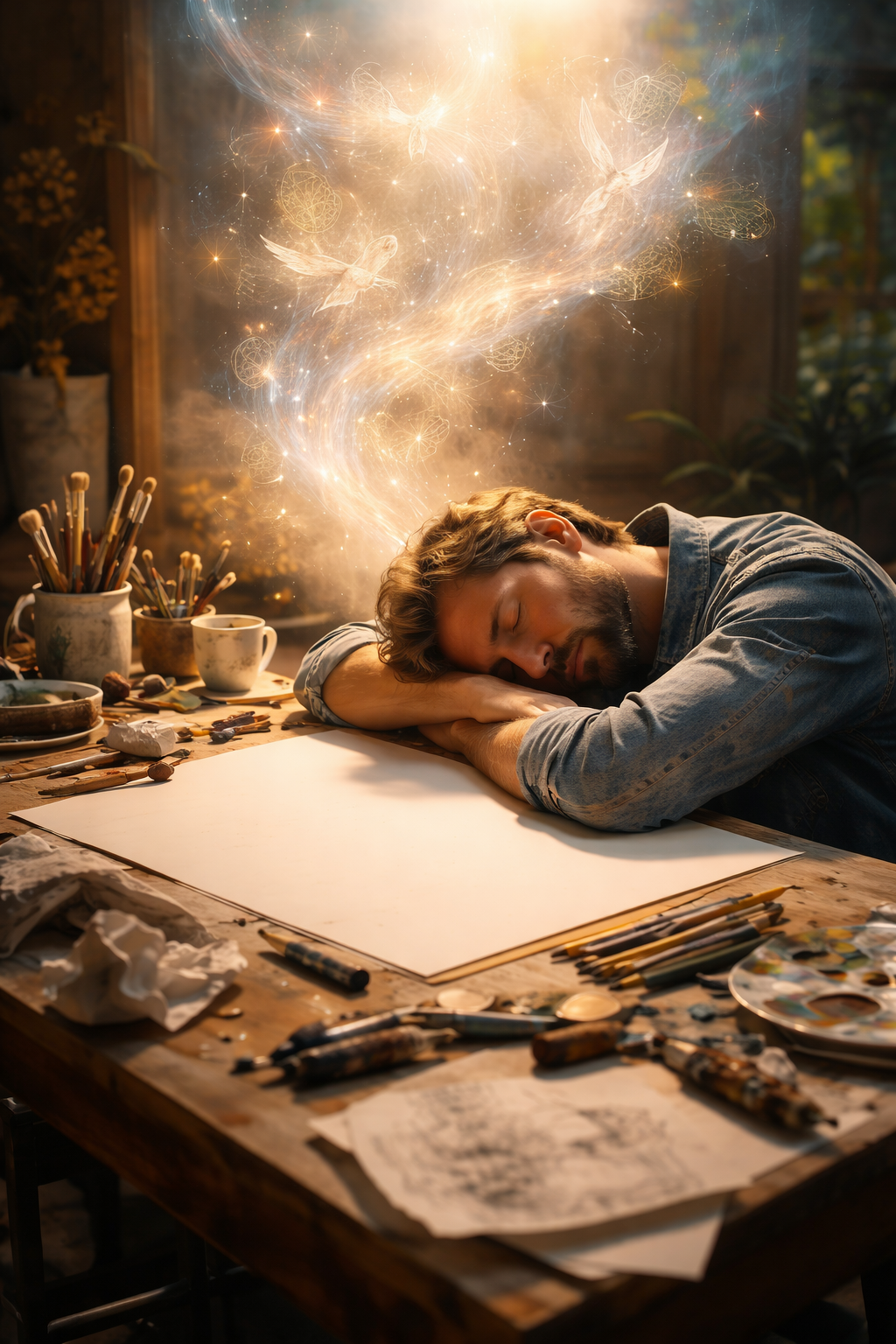
What Is Worth Preserving? On Art, Meaning, and the Refusal to Become a Machine
In an age of AI, CNC machines, and endless replication, a stone carver reflects on what truly gives art its worth. A meditation on message, meaning, and creating from the heart.
What is worth? What truly matters?
For the artist—whose life’s work is to interpret the world and reveal it back to others as faithfully as possible—these questions are unavoidable. We are lenses, shaped by perception, memory, belief, and experience. What we see, and how we choose to show it, matters.
Yet most people live at the surface.
We absorb culture, news cycles, feeds, and opinions as they’re handed to us—rarely slowing down, rarely going inward. Depth is traded for immediacy. Noise replaces meaning. And somewhere beneath it all, the question of what is actually worth saying gets buried.
Values matter.
They are the reason we take the stairs instead of the elevator—straining upward when no one is watching. They are the quiet force behind endurance, behind choosing difficulty for the sake of growth. Joseph Campbell called it the Hero’s Journey. But what is that journey for an artist?
I hope it goes beyond monetization.
Not producing merely to meet demand.
Not making objects to satisfy an algorithm or a market trend.
But creating for the message—not just the medium.
I was once asked a question that haunts many traditional craftspeople:
“Why carve stone by hand when a CNC machine could do it faster?”
I gave the expected answer—about time, intention, uniqueness, and how collectors value the human touch. All true. But the deeper answer came later.
We are not machines.
We are not CNC routers.
We are not AI models assembling images from databases of copies of copies.
We are the mind, the temperament, the patience, the struggle, and the heart behind the message.
A machine can replicate form.
It cannot excavate meaning.
AI generates images by averaging what already exists. CNC machines execute instructions flawlessly—but blindly. They do not wrestle with doubt. They do not pause in reverence. They do not fail, recover, or change course because something felt wrong.
What we do—what artists do—is hollow meaning out of the depths of lived experience and place it on display. That message can be copied, replicated, automated—but only after it has first been found. And that finding is human.
Yes, our labor is slow.
Yes, it is tedious.
Yes, it often feels like Renaissance work carried out on a 21st-century timeline.
Shortcuts are tempting—and sometimes necessary. But the goal has never been speed. The goal is clarity. Honesty. Saying something that matters.
Stone carving may look old. It may not appear revolutionary. But it is not the medium that matters—it is what is said through it. And often, even the artist doesn’t fully understand the message at first.
It must be done with the heart.
We carve our own stream, even knowing it will eventually join a river shaped by countless others. But the water is clean where it emerges. It is yours. No one can tell you where it leads—but it must be followed.
Some call this “following your bliss.”
Others call it vocation.
It is that thing you would do even if it paid nothing. Even if it cost you comfort. Even if it demanded sacrifice. Not for ego—but for service. For offering something true to others. And for aligning with something larger than yourself.
Remember this:
You matter.
Your message matters.
And the world does not need one more copy of a copy.
Do not let what you carry be lost.