
Something from Nothing
Sometimes the smallest act—a gesture so simple it almost feels insignificant—can set off a chain of events that changes everything.
There’s a quote that’s been sitting with me lately:
A true selfless act always sparks another.
I didn’t fully understand it until recently.
Not long ago, I wrote about a small moment that felt, in some quiet way, like a kind of intervention. A cardinal appeared at my window at a time when I had neglected something simple — feeding the birds. It nudged me to act, and I did. It was small, almost trivial, but the moment carried a strange weight to it. Something about it felt… aligned.
At the time, I described it as meaningful. Maybe even a little magical.
But what followed is what truly made me stop and reflect.
Shortly after that experience, I was contacted by a new client — someone generous, thoughtful, and unexpectedly connected to the work I’ve been doing. What struck me most wasn’t just the inquiry itself, but the reason behind it.
He had read my blog.
That alone surprised me. I often write with the assumption that these posts drift quietly into the void — unseen, unread, perhaps only glanced at in passing. But he didn’t just read it. He understood it.
He recognized something in it — not just the work, but the honesty behind it.
We shared similarities. Small details in life that mirrored each other. The kind of things that don’t show up in a portfolio, but somehow matter more than anything presented visually. And in that connection, something opened.
It led to the sale of a piece titled Fighting Chance — a piece that had been waiting quietly during a dry stretch of time.
Now here’s the part that challenged my previous thinking.
I’ve often believed that showing too much honesty — especially vulnerability — could work against you. That people might see it as weakness, something to avoid when making a decision about investing in an artist or their work.
But in this case, the opposite happened.
Honesty didn’t push someone away — it drew them closer.
It created trust. It created connection. And ultimately, it created movement where there had been stillness.
And that’s where the idea of the quote comes back.
One small act — feeding the birds.
One honest expression — writing openly.
One unexpected connection — a reader reaching out.
Each step seemed to lead to the next.
You could call it coincidence. You could call it timing. Some would call it karma.
But I’m beginning to think it’s something a little deeper than that.
There’s a kind of quiet order to things when we act from a place that isn’t calculated — when we do something simply because it feels right. Not for gain, not for recognition, but because it aligns with something internal we can’t fully explain.
And maybe that’s where meaning begins to unfold.
Following this, I felt compelled to give back — not out of obligation, but from a genuine place. Not from the head, calculating percentages or outcomes, but from the heart.
I made a donation to the Nature Conservancy of Canada — an organization that protects and restores natural habitats across the country.
It wasn’t a large amount. But that wasn’t the point.
The hope is simple: that somewhere, a small piece of land is preserved… that a creature finds space to live… that something continues because of it.
Something from nothing.
Or maybe, more accurately — something from something very small.
That’s what I’m learning.
We don’t always see the full chain of events. We rarely understand how one action leads to another. But every now and then, if you’re paying attention, you catch a glimpse of it.
And it’s enough to remind you to keep going.
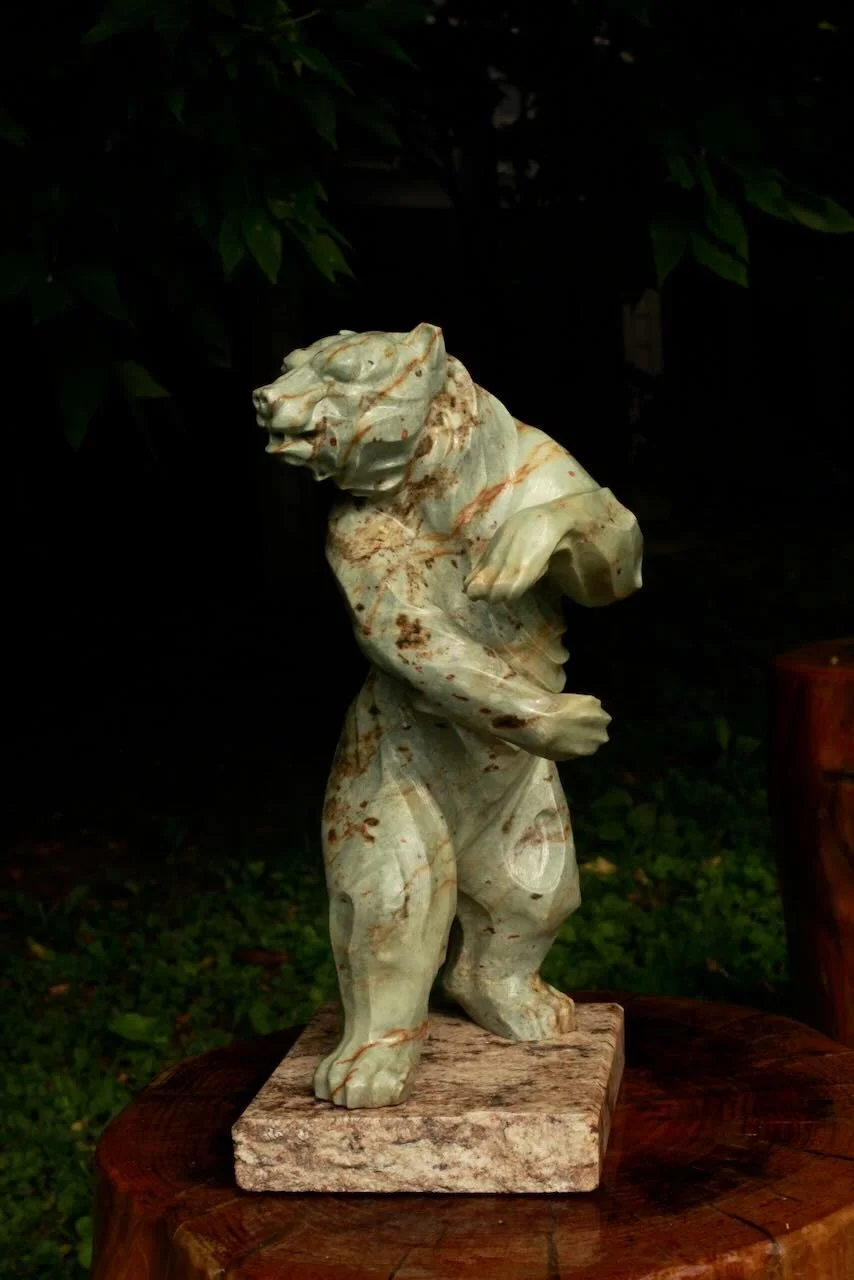
A Cardinal at the Window - The Fortune of the Forest Friends
Sometimes the smallest moments—a bird at the window, a lost object suddenly found—can feel like quiet reminders that we’re not as alone in this world as we think.
I have something to confess — and something to attest to. I’ll start with the latter.
In the chaos of getting ready for the weekend, we needed to give our daughter some medicine for a developing cough. The medication requires a device with a bright yellow cap on the back — large, unmistakable, the sort of thing you shouldn’t easily lose.
My wife called looking for it. My mother-in-law searched for it. I searched for it. We turned the entire floor upside down trying to find this bright yellow cap. Every object around the area had been lifted, flipped, or moved.
It was nowhere.
Now for the confession.
This year hasn’t been a strong one for art sales. Social media has a funny way of making everyone look like they’re wildly successful — “I went viral!”, “I’m a millionaire!”, endless attention-seeking theatrics designed to appease algorithms. But the reality behind the scenes is often quieter.
Economic pressures ripple everywhere. Many artists I know have felt the same downturn. When people tighten their budgets, art is often one of the first luxuries to disappear.
For years I’ve committed to sending 20% of my profits to conservation charities, particularly organizations that protect wildlife habitats like the Nature Conservancy of Canada. But with fewer sales and the constant investment needed to continue carving — stone, tools, equipment — I’ve been operating at a deficit for quite some time.
So this year my giving has been minimal. About $350 total, and even that came from a deficit.
On top of the financial pressure and the usual winter blues, I’ve been slipping in another way too. I haven’t been feeding the birds the way I normally do. Our feeder is usually filled every couple of days, but lately it had gone nearly three weeks without being replenished.
I justified it to myself. If I wasn’t making enough to give to conservation causes, maybe it made sense to ration the bird seed too.
Yesterday something interesting happened.
A cardinal landed in the tree outside our window.
That’s unusual. Cardinals are cautious birds, almost as wary of human movement as blue jays. They usually keep their distance. But this one came close, peering toward the window as if inspecting us.
My wife and I noticed him immediately. He lingered briefly, then flew away.
Something about it stuck with me.
I turned to my wife and said, “I’m going to go feed the birds. He’s probably asking for some.”
So I went outside and filled the feeder.
When I came back inside, I glanced at the spot where I had originally thought I’d left the yellow cap — the one we’d searched for everywhere.
And there it was.
Exactly where I had first remembered putting it.
I asked my wife if she had found it and placed it there while I was outside. She hadn’t. My mother-in-law hadn’t either. Both of them had searched that exact spot earlier, turning over everything nearby.
Yet somehow the cap had appeared in plain sight.
We stood there for a moment, both of us puzzled, replaying the search in our heads. It remains an unsolved mystery — and perhaps that’s how it should remain.
Because moments like this make me wonder if there are things happening in the world we simply don’t perceive.
We spend enormous effort trying to explain the mechanisms of the physical world, trying to make everything measurable, predictable, and provable. Yet sometimes small moments slip through the cracks of that certainty.
For centuries people have spoken about this idea: that we are spiritual beings experiencing a physical world. And when something unusual happens — a bird appearing at the right moment, a need suddenly being met — it nudges us toward that deeper perspective.
In many traditions, cardinals are considered messengers. Symbols of presence. Reminders that something beyond our immediate understanding is paying attention.
It made me think of the story of Elijah in the Bible. During a drought, he hides by a brook, and God instructs ravens to bring him bread and meat twice a day. An unlikely delivery system, but the message is simple: sometimes provision arrives through unexpected channels.
I’ve had similar little gifts from nature before — once finding a dried morel mushroom placed neatly on a back step, as if left there deliberately by some woodland friend.
Moments like these feel like tiny epiphanies. Small reminders that life may hold more connection and meaning than we usually notice.
In the middle of pressure, responsibility, and the constant grind of daily life, we forget that.
Jesus once said:
“Consider the ravens: They do not sow or reap, they have no storeroom or barn; yet God feeds them. And how much more valuable you are than birds! Who of you by worrying can add a single hour to your life?”
Sometimes we need reminders like that.
In the middle of obligations, stress, and uncertainty, it’s easy to forget that we are not entirely alone in this world. We share this land with countless other creatures, and caring for them — even in small ways like filling a bird feeder — is part of our responsibility.
Perhaps when we care for what’s around us, we’re reminded that we are cared for too.
As we care for each other, God will take care of us.
What Is Worth Preserving? On Art, Meaning, and the Refusal to Become a Machine
In an age of AI, CNC machines, and endless replication, a stone carver reflects on what truly gives art its worth. A meditation on message, meaning, and creating from the heart.
What is worth? What truly matters?
For the artist—whose life’s work is to interpret the world and reveal it back to others as faithfully as possible—these questions are unavoidable. We are lenses, shaped by perception, memory, belief, and experience. What we see, and how we choose to show it, matters.
Yet most people live at the surface.
We absorb culture, news cycles, feeds, and opinions as they’re handed to us—rarely slowing down, rarely going inward. Depth is traded for immediacy. Noise replaces meaning. And somewhere beneath it all, the question of what is actually worth saying gets buried.
Values matter.
They are the reason we take the stairs instead of the elevator—straining upward when no one is watching. They are the quiet force behind endurance, behind choosing difficulty for the sake of growth. Joseph Campbell called it the Hero’s Journey. But what is that journey for an artist?
I hope it goes beyond monetization.
Not producing merely to meet demand.
Not making objects to satisfy an algorithm or a market trend.
But creating for the message—not just the medium.
I was once asked a question that haunts many traditional craftspeople:
“Why carve stone by hand when a CNC machine could do it faster?”
I gave the expected answer—about time, intention, uniqueness, and how collectors value the human touch. All true. But the deeper answer came later.
We are not machines.
We are not CNC routers.
We are not AI models assembling images from databases of copies of copies.
We are the mind, the temperament, the patience, the struggle, and the heart behind the message.
A machine can replicate form.
It cannot excavate meaning.
AI generates images by averaging what already exists. CNC machines execute instructions flawlessly—but blindly. They do not wrestle with doubt. They do not pause in reverence. They do not fail, recover, or change course because something felt wrong.
What we do—what artists do—is hollow meaning out of the depths of lived experience and place it on display. That message can be copied, replicated, automated—but only after it has first been found. And that finding is human.
Yes, our labor is slow.
Yes, it is tedious.
Yes, it often feels like Renaissance work carried out on a 21st-century timeline.
Shortcuts are tempting—and sometimes necessary. But the goal has never been speed. The goal is clarity. Honesty. Saying something that matters.
Stone carving may look old. It may not appear revolutionary. But it is not the medium that matters—it is what is said through it. And often, even the artist doesn’t fully understand the message at first.
It must be done with the heart.
We carve our own stream, even knowing it will eventually join a river shaped by countless others. But the water is clean where it emerges. It is yours. No one can tell you where it leads—but it must be followed.
Some call this “following your bliss.”
Others call it vocation.
It is that thing you would do even if it paid nothing. Even if it cost you comfort. Even if it demanded sacrifice. Not for ego—but for service. For offering something true to others. And for aligning with something larger than yourself.
Remember this:
You matter.
Your message matters.
And the world does not need one more copy of a copy.
Do not let what you carry be lost.
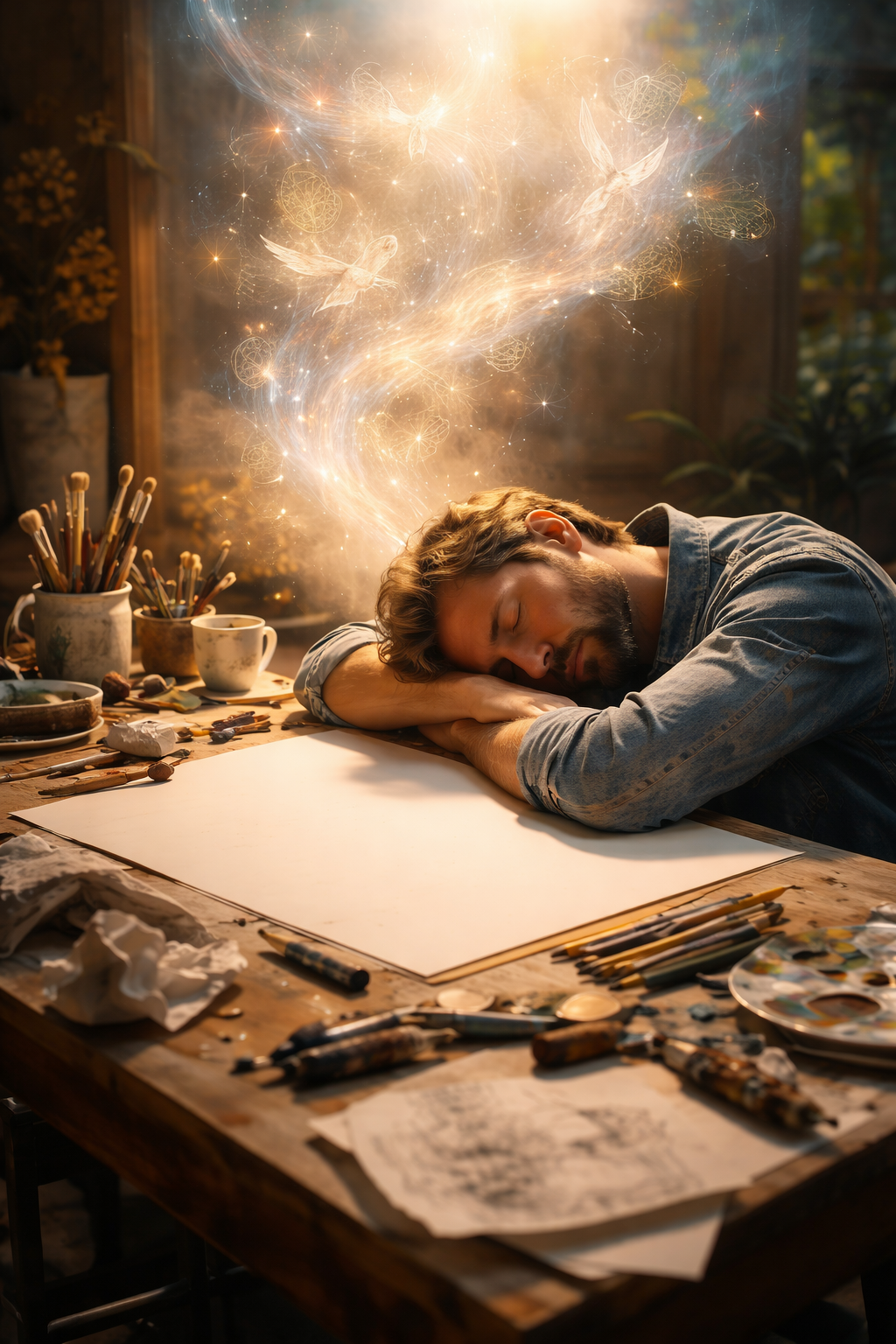
When the Mind Steps Aside: Discovering the Hidden Hand in Art
I believe I’ve stumbled upon something remarkable—perhaps even groundbreaking—about how we live and create with intention. It’s an insight into what happens when we trick the left brain—that logical, critical part of ourselves—into stepping aside long enough for something greater to emerge.
My high school art teacher used to say, “Let the right brain take over.” He’d crank up the music, stop teaching technical details, and just let us create. The idea was simple: music and rhythm help us shift from the analytical left hemisphere to the intuitive right. In that space, we loosen up. We begin to feel more than think.
Neurologically speaking, when the left brain quiets down, we can enter a blissful, flow-like state. But if it shuts off completely, we lose access to logic, speech, or even basic coordination. So the magic seems to live in that in-between—where intellect hums quietly in the background while intuition takes the lead.
The Experiment with My Daughter
A few days ago, I was looking at Pinterest images of polar bears before sitting down to draw with my daughter. She loves to scribble freely, without rules or expectations. Sometimes she’ll glance at her drawing and casually say, “cat,” or “bird,” and sometimes I may grasp something alike out of it.
Inspired, I decided to draw the way she does—fast, loose, without trying. About 25 seconds in, while my hand moved almost unconsciously, a polar bear’s face began to appear from the chaos of scribbles. Upside down, no less. And astonishingly, it was better—more alive—than what I could have drawn had I tried.
A few days later, I tested it again—drawing upside down this time while she watched from across the table. Again, the result was more natural, more expressive, more true.
The Great Egret Revelation
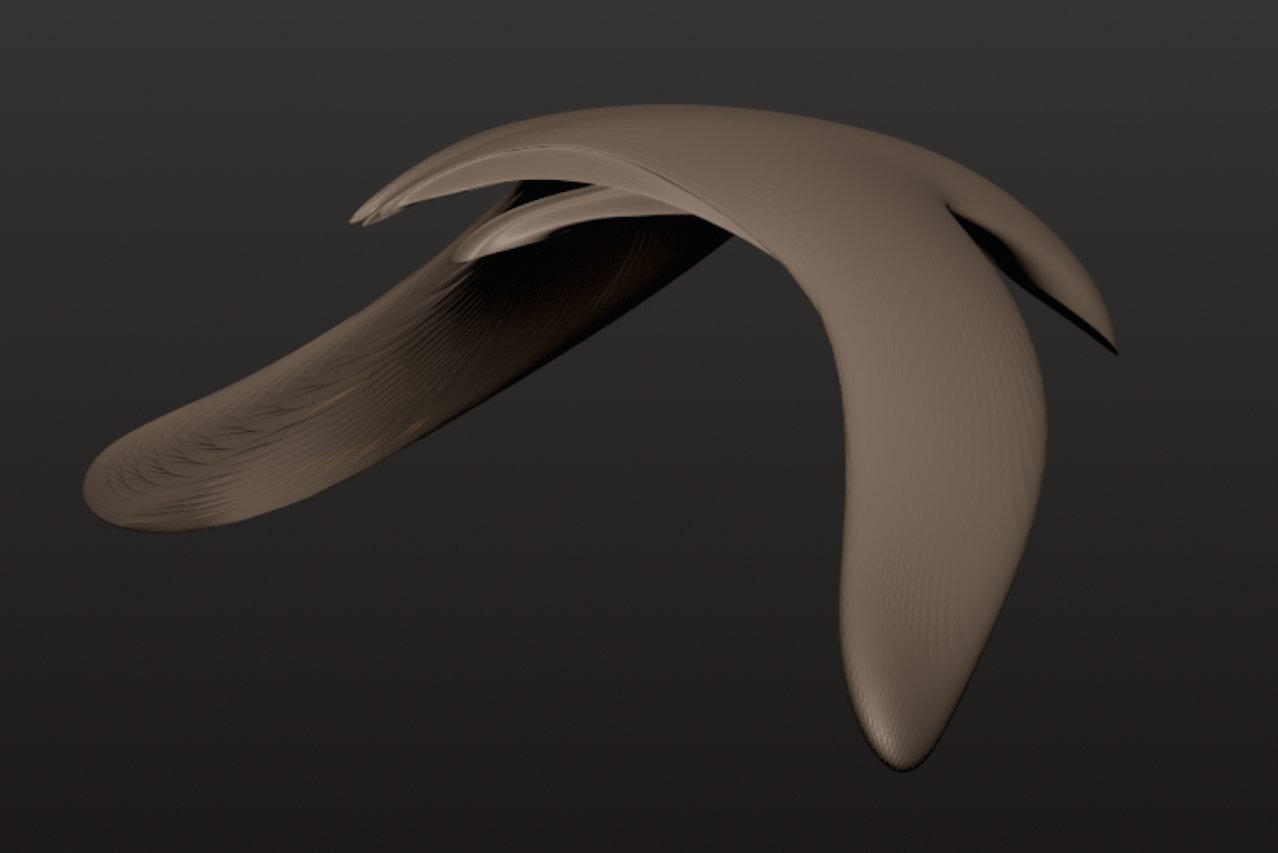
Recently, I was refining a 3D model of a Great Egret—a tall, elegant heron-like bird. I spent hours fine-tuning the proportions and details, guided by countless reference photos. Then, I put the file aside and started working on something abstract, purely for play.
And then it happened again. Out of the freeform shapes, without planning or intent, emerged the unmistakable form of a Great Egret. The likeness was uncanny—and somehow more beautiful than my deliberate, technical render.
That’s when I realized: my intellectual mind had laid the groundwork. It had studied, measured, analyzed. But it was only when I let go—when I stopped trying—that something extraordinary appeared.
The Art of Doing Without Doing
In Zen, this is known as Wu Wei (or Wei Wu Wei): doing without doing. It’s the state of effortless action, where mastery and surrender become one. The Zen archer doesn’t aim with his mind—he allows the arrow to find its target through presence.
There’s a story of a master archer who, when challenged by a student, drew his bow in complete darkness and split the back of a previous arrow. The shot was not a display of skill, but of connection—between spirit, mind, and motion.
Becoming the Instrument
In the same way, when artists let go of the ego—the “little self” that needs to control and perfect—we make space for something larger to flow through us.
Remote viewers describe a similar process: using intuition to perceive distant targets with uncanny accuracy, bypassing logic entirely. Could it be that this same something—this consciousness beyond the intellect—moves through us when we create?
Maybe true art begins where the self ends.
When we lend ourselves to something greater than our technical mind, we receive what can only be described as extraordinary. The key is learning how to let the extraordinary happen—by getting out of our own way.
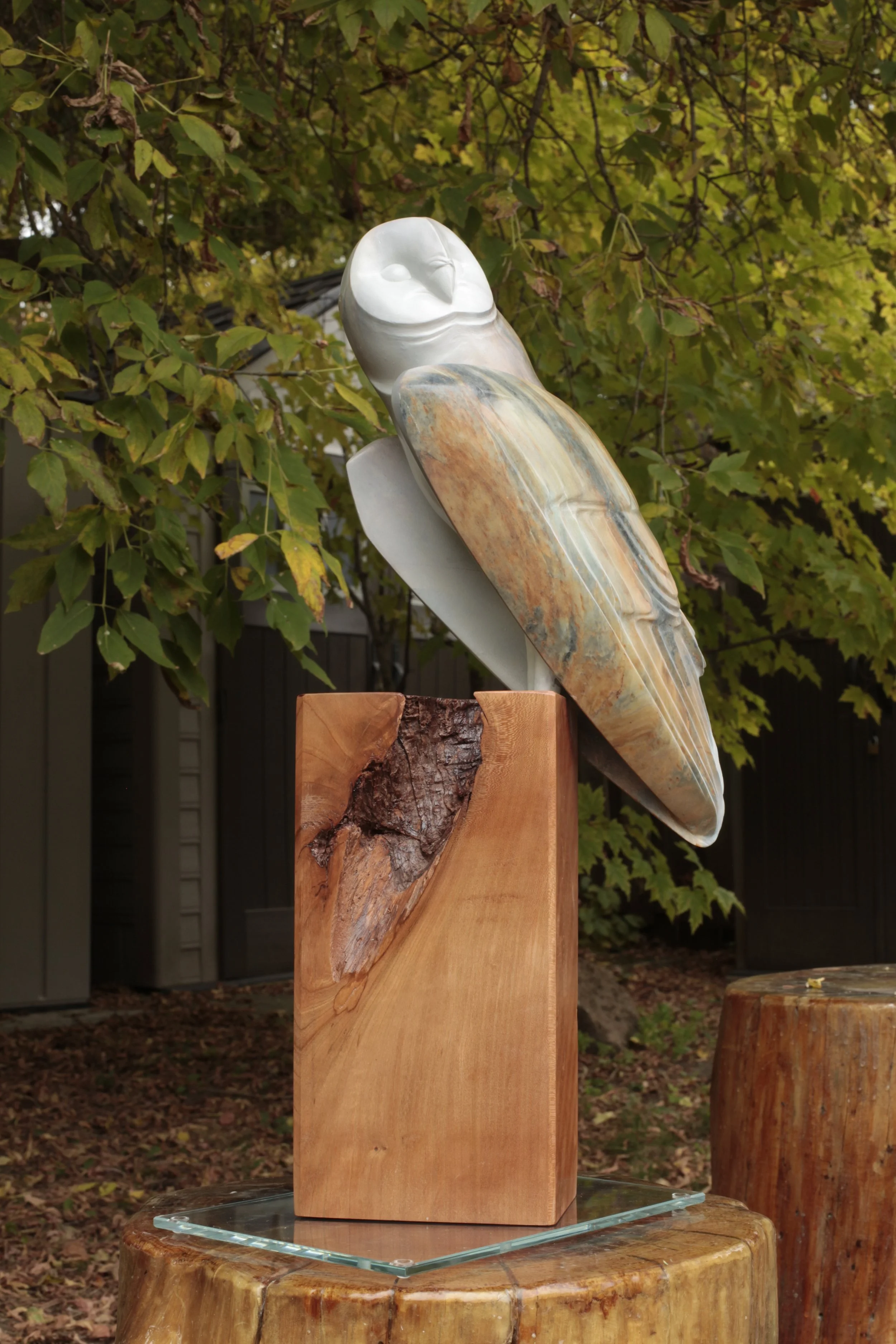
Looking Up: Lessons from an Owl and the Art of Letting Go
A reflection on carving, faith, and fatherhood—how one artist found spiritual meaning in a barn owl sculpture that reminded him of his daughter and the importance of looking up.
There are times I’ve fallen in love with a sculpture as I’ve been working on it. Perhaps I’m not the only one who’s felt this way—but for me, it’s increasingly rare. The constant inner critic is always present, whispering in the background, even as the artist within searches for appreciation and gratitude in the process. At some point, those two voices—the critic and the creator—merge. And in that merging, something magical happens: flow. The careful turns careless, the mind quiets, and the stone begins to speak.
The last piece I produced began with an extraordinary reference—a young barn owl, wings slightly spread, head raised toward the sky as if watching the heavens. The posture reminded me of my daughter. That innocent, upward gaze of wonder. How often do we forget to look up as we grow older? As we stand taller, we begin to see others as peers—or worse, as competition—each of us fighting never to look up again.
But maybe looking up is exactly what we need to do more often.
Our mission, whether as artists or simply as people, is to remain teachable—to learn from something higher, to serve others as if we were entertaining the children of God. To be both young and old at once requires humility and adaptability. It calls on us to forgive, to turn the cheek, and to love even our adversaries.
When I carve an owl, I often sense that same paradox: a creature both feared and revered. Its silent watchfulness commands respect, but in its eyes I see gentleness, understanding, and beauty. In this particular owl, I saw my daughter’s spirit—bright, alert, full of promise.
So when it came time to bring the sculpture to the gallery in Niagara-on-the-Lake, it wasn’t easy. Letting go never is. Yet, I know there will be more. I will see my daughter in many future works and strive to make each piece more beautiful than the last—for love’s sake, for the art, and for whoever the piece connects with. Because in the end, we’re all connected in ways we can’t yet imagine.
Chasing Ghosts: The Struggle and Truth of an Artist’s Life
An honest reflection on the struggle between passion and profit, perfection and truth. Why chasing ghosts of perfection can burden us—and how staying true to our craft carries deeper meaning.
A little honesty here.
As an artist, I often wrestle with the gap between the effort I pour into a sculpture and the income it brings back. The balance is rarely even. For every hour invested in a piece, there’s the weight of tools, materials, and years of skill behind it—all against a reality where profit margins sometimes point to loss rather than gain.
If you’re not an artist, perhaps it’s easier to picture another trade. Imagine being a carpenter. Your shop has to be massive. Your investment in wood is significant. Your skills take decades to sharpen. And when your work finally reaches a level of perfection, few people can truly afford it. That’s the paradox—mastery often makes the work rarer, but not always more profitable.
Yet I can’t turn away from this path. The detail of the craft pulls me in. Stone carving is an ancient art, one that carries traditions worth preserving. There’s meaning in taking something inert—stone—and giving it a form that might outlast us, transforming it into something that feels immortal.
But the pursuit isn’t easy. Striving for excellence can become a mirror, one that reflects not just our progress but also our insecurities. It’s hard not to feel burdened when the practice demands so much and rewards so little. In times like these, when it feels as if the benchmark for performance keeps climbing higher, it’s tempting to believe that some unseen hand is forcing us to chase endlessly.
This is what I think of as “chasing ghosts.” These ghosts are the illusions of perfection—false visions of what we think we should be, or what others expect us to be. But perfection is an illusion. We are all evolving, becoming truer versions of ourselves, shaped not by flawless outcomes but by persistence, honesty, and individuality.
Sometimes, simply staying true to our craft—whether it’s widely celebrated or quietly overlooked—is more meaningful than any price tag. Art is not only about success in the eyes of others; it’s about grounding ourselves in something real, something lasting.
I hope, in time, we learn to stop chasing these ghosts. To lay them to rest. And to continue forward, more true to ourselves than any imagined version of perfection could ever be.
Details Matter: From Studio Setup to Digital Presence
Days off often feel like a tug-of-war between carving, enjoying the moment, and keeping up with the details of life. From ticks in the grass to cords in the studio, every detail matters. Recently I streamlined my workspace and updated my portfolio with new works—because the digital presence is just as important as the physical.
The tug-of-war on a day off is real. Part of me knows I need to get downstairs to carve, but the other part just wants to sit outside, sip coffee, and enjoy the breeze. The details matter, though—and I’ve learned the hard way. The last time I ignored the “small stuff,” I missed a tick no bigger than a poppy seed on my foot.
Yesterday’s energy went into prepping my studio: setting up a new carving table, arranging cords and lights, and streamlining everything for safety and efficiency. I like things neat, with each tool exactly where it needs to be. Now the space is ready for the work ahead.
In the spirit of “details,” I’ve also updated my portfolio with a few pieces that hadn’t been shared before—outside of the occasional blog mention. In today’s world, we live in two spaces: the physical galleries where art can be experienced in person, and the digital spaces where it must also live to be found. I don’t have the time or resources to run a shop of my own, so my sculptures find homes in galleries. But managing an online presence has become its own kind of craft, and it takes just as much dedication.
So take a look through my updated portfolio when you can, and explore the new works I’ve added. My efforts in both stone and digital spaces feel more meaningful when they’re seen. And if you’re curious, you can always find more through my YouTube process videos, my Instagram feed, or even on Facebook and Threads. Every detail adds up—and hopefully, each step reveals more of the story behind the work.
