
Looking Up: Lessons from an Owl and the Art of Letting Go
A reflection on carving, faith, and fatherhood—how one artist found spiritual meaning in a barn owl sculpture that reminded him of his daughter and the importance of looking up.
There are times I’ve fallen in love with a sculpture as I’ve been working on it. Perhaps I’m not the only one who’s felt this way—but for me, it’s increasingly rare. The constant inner critic is always present, whispering in the background, even as the artist within searches for appreciation and gratitude in the process. At some point, those two voices—the critic and the creator—merge. And in that merging, something magical happens: flow. The careful turns careless, the mind quiets, and the stone begins to speak.
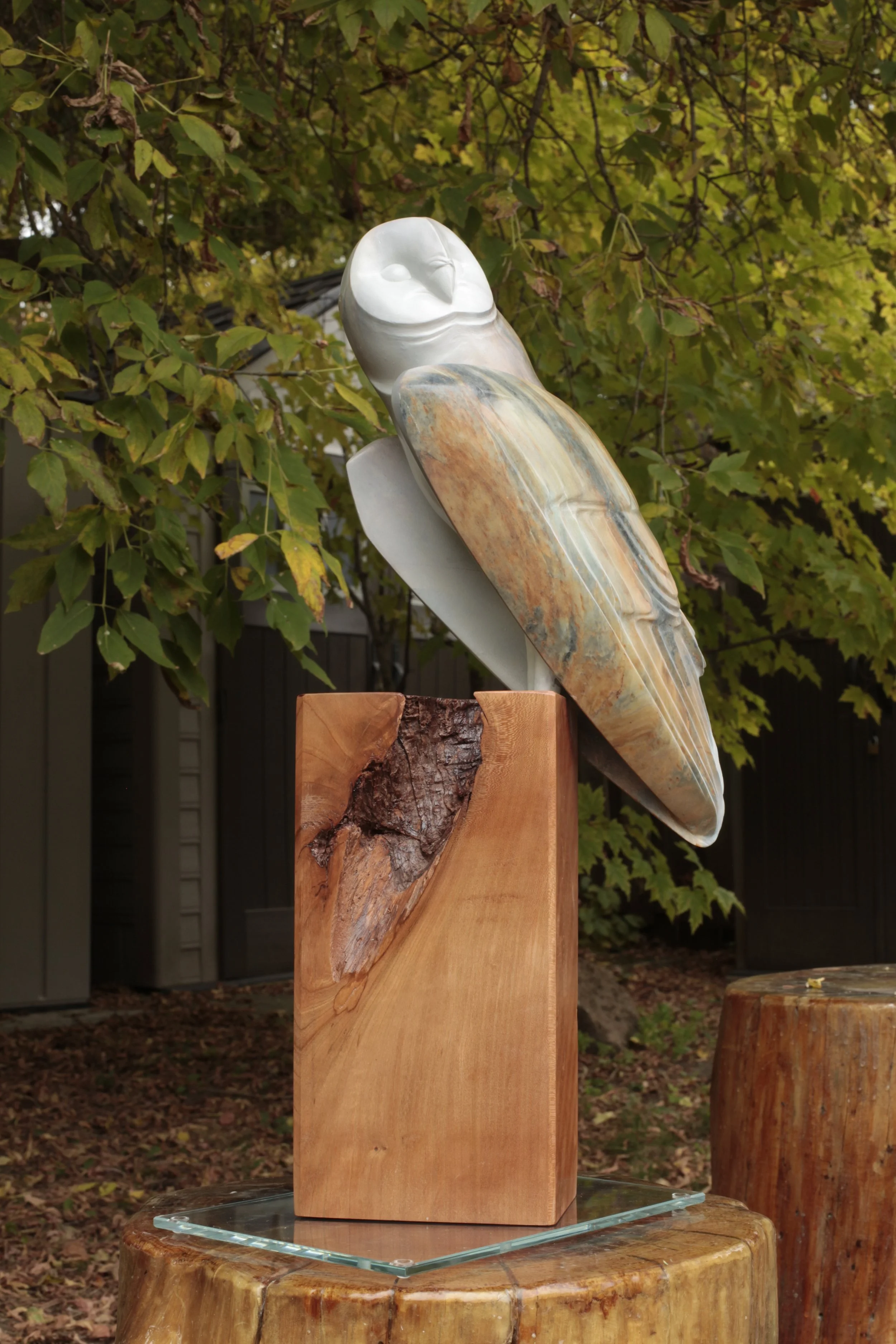
The last piece I produced began with an extraordinary reference—a young barn owl, wings slightly spread, head raised toward the sky as if watching the heavens. The posture reminded me of my daughter. That innocent, upward gaze of wonder. How often do we forget to look up as we grow older? As we stand taller, we begin to see others as peers—or worse, as competition—each of us fighting never to look up again.
But maybe looking up is exactly what we need to do more often.
Our mission, whether as artists or simply as people, is to remain teachable—to learn from something higher, to serve others as if we were entertaining the children of God. To be both young and old at once requires humility and adaptability. It calls on us to forgive, to turn the cheek, and to love even our adversaries.
When I carve an owl, I often sense that same paradox: a creature both feared and revered. Its silent watchfulness commands respect, but in its eyes I see gentleness, understanding, and beauty. In this particular owl, I saw my daughter’s spirit—bright, alert, full of promise.
So when it came time to bring the sculpture to the gallery in Niagara-on-the-Lake, it wasn’t easy. Letting go never is. Yet, I know there will be more. I will see my daughter in many future works and strive to make each piece more beautiful than the last—for love’s sake, for the art, and for whoever the piece connects with. Because in the end, we’re all connected in ways we can’t yet imagine.
The Silence Between Moments
What if the moments we long for are only illusions—yet art allows us to hold them still?
In my latest blog post, I reflect on time, memory, and the quiet power of a piece I recently finished. It’s a reminder of the stillness our grandparents knew, the simplicity we often forget, and the silence that carries meaning.What if the moments we long for are only illusions—yet art allows us to hold them still?
In my latest blog post, I reflect on time, memory, and the quiet power of a piece I recently finished. It’s a reminder of the stillness our grandparents knew, the simplicity we often forget, and the silence that carries meaning.
We are here. Right now. Alive, awake, and living this moment. Yet one day, we will wish we could stay—while today, we seem always to be rushing forward, saying “go.”
There’s a constant pull into the future, a curiosity that drives us to discover what lies ahead. But equally strong is the quiet ache that calls us back, urging us to relive the past. Is our nostalgia simply the sweetness of memory, or is it a veil that softens our pain, covering old wounds with a gentle filter?
At times, life feels like heaven. At others, like hell. Perhaps, in truth, it is neither. What if all of this—the triumphs, the sorrows, the illusions of “good” and “bad”—is simply a construct? A version of reality created by the mind, shaping our perception of existence.
This realization came to me recently: if reality is only an illusion, then the spirit within longs to be free of it. Awakening often comes only through great trials—sometimes even at the brink of death, when we’re forced to let go. Near-death experiences and other profound encounters open a door to a truth beyond this version of the world.
And yet, art holds a special kind of power. It can suspend a single moment, allowing us to revisit it—not as memory distorted by time, but as something preserved, alive in itself.
This is what I found in my most recent piece, one I have been working on slowly over the past two years. It’s a simple scene, yet filled with quiet peace—a kind of stillness our grandparents or great-grandparents would have recognized deeply. Their days were anything but easy, especially those who worked the land without machines, yet there was a profound simplicity in their way of life.
The silence of the piece is tangible. I drew from my own photograph, remembering the stillness of that moment: no vehicles in the distance, only two horses, calm and unmoved by my presence. The mediums—conte, colored graphite, graphite, and grey paper—helped capture that subdued quiet, that weight of silence.
A line from Gordon Lightfoot comes to mind, from his song about the building of the Canadian railway: “And many are the dead men, too silent to be real.” One day, we too will join that silence. Art reminds me of this truth—that peace can be found in memory, that life is fleeting, and that perhaps freedom lies in shedding the illusions we cling to.
For now, as Lightfoot also sang, “Open your heart, let the lifeblood flow, gotta get on our way ‘cause we’re moving too slow.”
May we carry forward with open hearts, remembering the silence, and finding peace in the spaces between moments.

