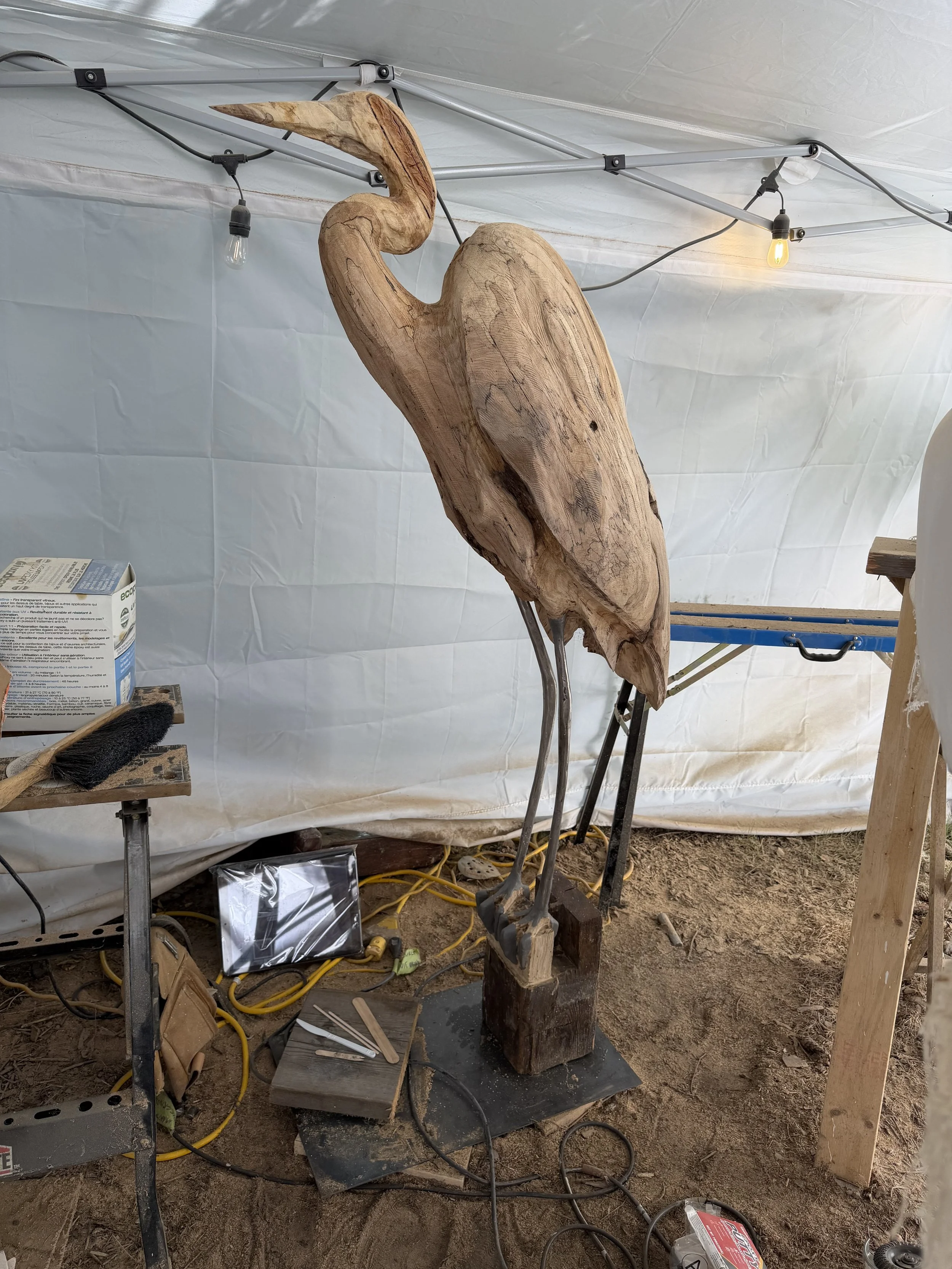
The Value Connection
What makes something feel real to us? In an age of endless reproduction, generated imagery and instant creation, perhaps we are beginning to recognize that the value of art lies not only in what we see, but in the human presence behind it. The material, the labour, the intention and the story of its making all become part of the work.
I have been thinking lately about what makes something feel real to us.
Not merely real in the sense that it exists, but real in the deeper sense—that it carries something of the person, place, experience, or intention from which it came. I think this connection is part of what makes art alive.
We live in a time when images and stories can be produced almost instantly, and when it has become increasingly difficult to know what we are looking at. Photographs can be altered, stories fabricated, and images generated without any physical encounter between an artist and the subject they appear to represent. The phrase AI slop has emerged to describe some of this material, but perhaps the more interesting question is not whether something was made with AI. It is why we have begun to hunger so strongly for evidence of authenticity.
I experienced this myself recently. I came across a story online that seemed moving and entirely plausible. It took only a few minutes before I began noticing inconsistencies in the images and realized that what I was looking at had been constructed rather than witnessed.
The strange thing was that the story itself had been carefully designed to produce a feeling. In that sense, it had succeeded. Yet once I understood that the apparent evidence was fabricated, something disappeared. The emotional connection I had formed with it could no longer rest on the same foundation.
Perhaps this is because we do not only value the image. We value the story behind the image.
What makes a work of art real?
Consider a great work from the past. We may stand before a sculpture such as Michelangelo’s David and admire its proportions, its surface, its physical presence and its extraordinary technical achievement. But our understanding of the work is also inseparable from the knowledge that a particular person stood before a particular block of marble and devoted an enormous portion of his life to transforming it.
The sculpture carries more than an image.
It carries a history.
We know something about the artist, his ambitions, his struggles, his convictions and the world in which he worked. We know that the marble resisted him. We know that decisions were made with a chisel in hand. The object before us becomes a meeting point between our own experience and the life of another person who existed centuries before us.
This does not mean that every great work must be made entirely by one pair of hands. The Renaissance workshops themselves complicate that idea. Raphael employed a substantial studio, and Michelangelo also worked with assistants at various points in his career. Art has never been quite as simple as the romantic image of the solitary genius.
What matters is something deeper than the number of hands involved.
It is the presence of conviction.
The difficulty of the thing
There is another reason we value handmade objects: we understand that they cost something.
Time is one of the most difficult things for us to fake.
When we encounter a hand-carved piece of stone, we can sense that the material demanded a particular kind of attention. A mistake cannot simply be undone with a keystroke. The stone has its own grain, fractures, density and character. The artist has to respond to what is actually there.
This relationship between resistance and intention is part of what interests me about sculpture.
The finished object is not simply an image that has been reproduced in a material. It is the consequence of a sustained relationship between the artist and the material.
That distinction has become increasingly meaningful in a world where almost anything can be reproduced.
A duplicate of a bronze sculpture may be visually indistinguishable from another cast, yet its meaning can be different depending upon its place within the artist’s body of work, its provenance, its edition, and the story of its creation. Value does not necessarily reside in physical uniqueness alone. It can reside in the relationship we understand the object to have with its maker.
The same is true of many things outside of art.
We tend to treasure objects that reveal something about where they came from.
The temptation of the shortcut
Artists have always looked for ways to overcome limitations.
The history of art is filled with techniques, tools, assistants, templates, casts, studies, machines and methods that allow an artist to accomplish something that would otherwise require an impossible amount of time. There is nothing inherently wrong with this. The history of making is, in many ways, the history of finding better ways to bring an idea into physical form.
The danger comes when the method begins to replace the conviction.
A shortcut can preserve an artist’s intention, or it can become a substitute for having one.
That distinction is increasingly difficult to see.
Perhaps this is why there is so much suspicion surrounding automatically generated imagery. The problem is not necessarily the technology itself. Behind any image there can still be a human mind, an idea, an intention and even a genuine emotional impulse. But when the connection between those things and the finished work becomes difficult to understand, we instinctively begin searching for what is missing.
We want to know where it came from.
We want to know why it exists.
We want to know whether someone cared enough to make it.
What survives
This is part of what draws me to the older traditions of making.
Stone, wood, bronze, clay and other enduring materials have been carried forward through generations not simply because they are old, but because they continue to give the artist something to wrestle with. They impose conditions. They resist. They record touch. They reward patience.
There is something humbling about working within those limitations.
A stone does not care what I intended to make. It gives me what it gives me, and the work becomes a conversation between that reality and the vision I brought to it.
Perhaps this is one reason art can remain meaningful long after the artist is gone.
The material survives.
The marks survive.
And, if the work is successful, something of the person survives with them.
This is the connection I think we are really searching for.
Not merely proof that something was handmade. Not nostalgia for an older technology. Not even an objection to the new.
Rather, we are looking for the evidence of a human presence behind the thing we are seeing.
We want to feel that someone stood there.
That someone looked.
That someone struggled with the material.
That someone had something to say.
And perhaps this is ultimately what gives art its life: not the medium itself, but the light that passes through it.
Stone can carry it.
Bronze can carry it.
Wood can carry it.
So can an image on a screen.
But whatever the medium, the most lasting work begins with something that cannot be manufactured for us—the genuine conviction of the person who made it.